Everything has fallen, and the ground still holds: that is the Ten of Swords in a tarot reading, the card of rock bottom. Upright, the Ten of Swords meaning is a painful ending that is now complete, whether a relationship, a job, a plan or a way of thinking, often with the exhausted relief of knowing it cannot get any worse. Reversed, it usually means getting back up and recovering, though it can also show someone refusing to accept an ending, or replaying the fall long after it is over.
As a 10 of Swords tarot card meaning, this is the heaviest moment in the suit, yet it is also the last numbered step, with a sun already on the horizon. Tarot works here as a way to see the shape of a hard moment, not as a ruling on your life. It cannot tell you what someone else intends, promise when relief will come, or decide an outcome for you; it can help you name what has ended and notice what is still yours.
- Upright keywords: rock bottom, a completed ending, betrayal, collapse, exhaustion, the worst being over.
- Reversed keywords: recovery, getting up, survival; or resisting an ending, reliving the fall, catastrophizing.
- Yes or no: upright, no; reversed, a slow yes for questions about recovering and starting again.
- Element and astrology: Air; the Sun in Gemini, the third decan of Gemini (20 to 30 degrees).
- Golden Dawn title: Lord of Ruin.
- Number and sphere: ten, the last numbered card of Swords, linked to Malkuth, the Kingdom, on the Tree of Life.
Ten blades on an empty shore: reading the picture
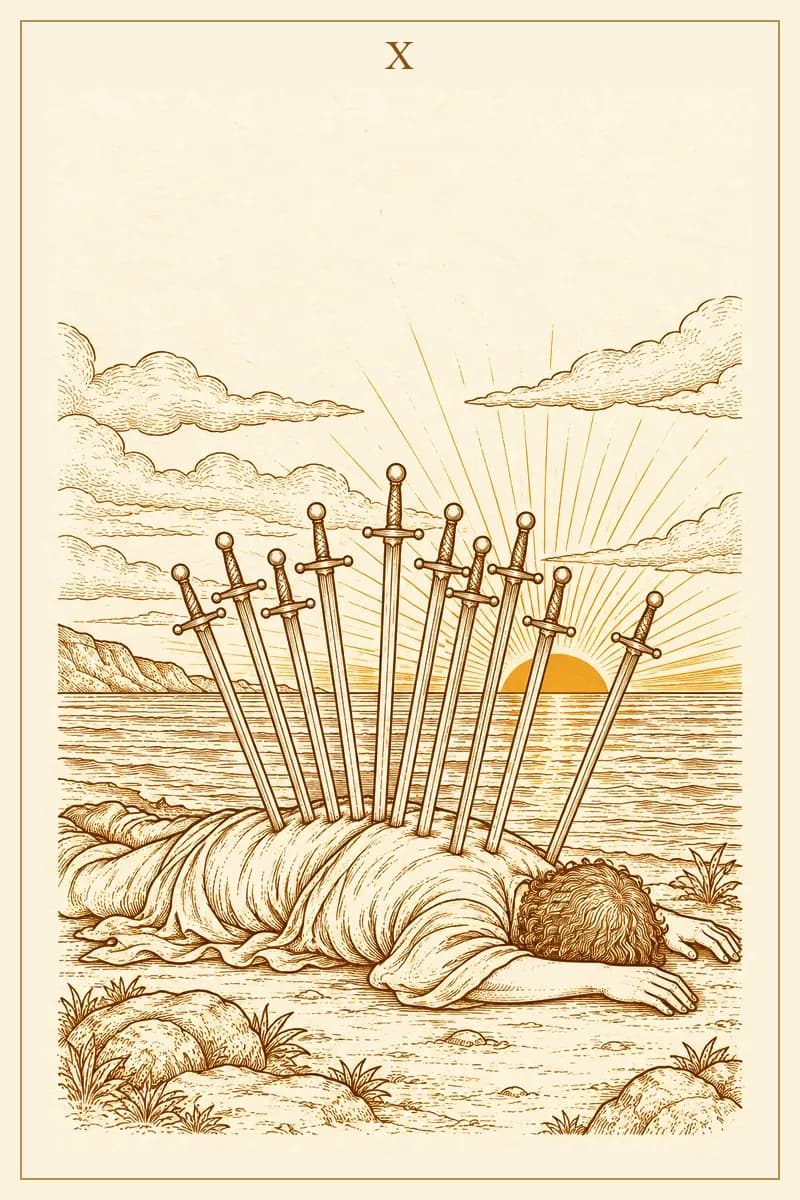
A figure laid out on the sand
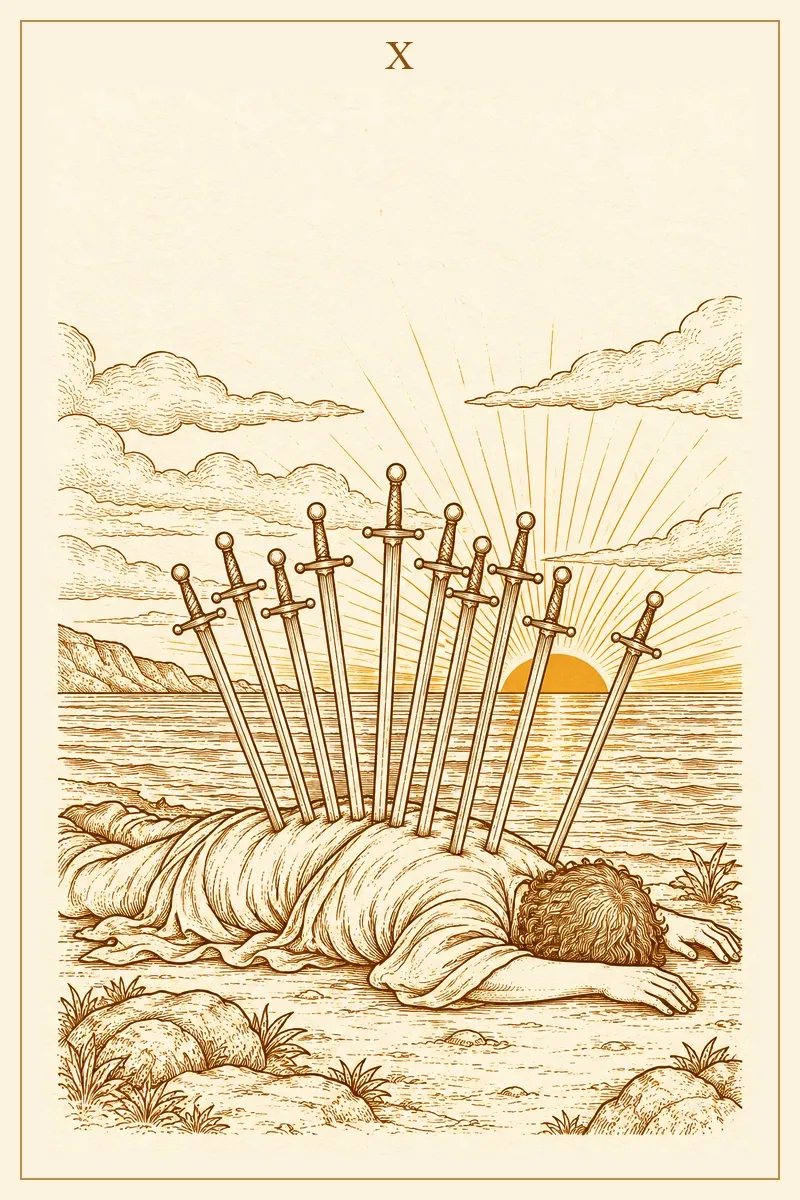
The scene is a beach beside a wide, calm sea. A single figure lies face down across the foreground, covered by a pale, heavy cloth that gathers in folds around the legs. Curly hair shows at the right, but the face is pressed into the crook of an arm, so we never see the expression. Both arms reach forward over the sand, hands open and slack, fingers resting where they fell. Nothing in the pose is struggling anymore, and that stillness is part of the meaning: the effort is over.
Ten swords standing in a fanned row
Ten swords stand upright along the figure's back, from the shoulders to the hips, their points hidden in the cloth. They lean at slightly different angles, like a fan opened behind the body, the tallest in the middle. Each is a plain long sword with a round pommel and a straight crossguard. One blade would have finished the story; ten makes it almost theatrical. Many readers take that excess as a hint that the mind is telling the story at full volume: the pain is real, but its drama may outgrow the facts.
A half sun on the water and an open sky
Behind the swords, a half sun sits on the horizon at the right, and gold rays fan upward through the gaps between the blades, laying a bright path across the water toward the shore. Low cliffs close the view on the left and soft clouds drift on both sides, yet the sky is pale and open, with no storm overhead. The picture supports reading this sun as rising: the only strong gold on the card is the dawn, just beyond the figure's outstretched hands. The ending happened here, and the next day is already beginning on the same shore.
Ten of Swords upright: when the end has fully arrived
Upright, the Ten of Swords says something has finished, and that the finish hurt. It is not a warning that trouble might come; it is the scene after. It often names a situation that has been failing for a while and has now reached its last point, or a shock that brought everything down at once. There is grief in it, sometimes humiliation, and also a strange relief: you no longer have to brace for the blow. You cannot fall further than the ground, and the figure lies on solid earth.
Endings the card often points to
- A relationship that ended in a way that cannot be undone.
- A job loss, a business that closed, or a project that will not be revived.
- A plan or a belief that collapsed under its own weight.
- A long conflict that stopped because one side had nothing left to give.
- A season of worry that ended with the feared thing happening, and you still here.
Betrayal and the blade in the back
Because every sword is in the figure's back, the card has a long association with betrayal: being let down, talked about or undermined by someone you trusted. It is one classic reading, not the only one, so weigh it when the question or nearby cards point to another person's actions. In that context the card asks you to see the injury clearly, without excusing it and without letting it become the whole of who you are. It confirms that the wound is real and that the bond, at least in its old form, has run out.
Ten blades for a story one would have ended
The Ten is also the card of the mind at its harshest. Swords are the suit of thoughts, words and judgments, and by the tenth card the thoughts have piled up into a verdict: everything is ruined, nothing will work, this is the end of me. Sometimes the facts match that verdict; often they match only part of it. The card asks you to separate the event from the commentary. A job was lost, and that is one sword. "I will never find work again" may be another nine you are adding yourself.
Ten of Swords reversed: rising, resisting or replaying
Reversed, readers often picture the swords loosening and the figure beginning to stir. The reversal has three common readings, and the context decides which one you are holding.
Getting up off the sand
The most frequent reading is recovery. The ending still hurts, but you have survived it and are starting to notice that you have. Sleep comes back, small plans return, and the collapse is becoming a story you can tell rather than one that tells you. It is not a sudden comeback; it is the first time the figure lifts their head and sees the sun.
Holding on to what is already over
A harder reading is resistance. The ending has happened, but part of you keeps pulling at it: checking an ex's profile, arguing a decision that was final, pouring money into a venture that has already failed. The pain is being stretched out by a refusal to lie still long enough to heal. Accepting the end is not giving up; it is what allows the swords to come out.
Falling again inside your head
The third reading is replay. The crisis is over in the outside world, yet the mind keeps returning to the beach: rehearsing the worst moment, picturing a second collapse before anything has gone wrong, treating every small setback as proof the first will repeat. Here the reversal asks you to notice the loop rather than obey it.
Telling the three apart
- Neighboring cards. Restful or healing cards such as the Four of Swords, the Six of Swords or The Star support recovery. Worry cards such as the Nine of Swords or the Eight of Swords lean toward replay, and the Two of Swords, a card of refusing to look, often points to resistance.
- Your energy. Recovery feels like strength slowly returning. Resistance feels like effort spent on something that will not move. Replay feels like fear about events that have not happened.
- The calendar. If the ending is recent and you are rebuilding, read recovery. If it is long over and still running your days, read replay.
When a relationship reaches its Ten of Swords
In love readings the Ten of Swords is one of the clearest signs that something has ended, and a reminder that the shore is still under you.
After a breakup or a betrayal
Upright after a breakup, the card says the relationship as it was is over, and that the ending cut deep. This differs from the Five of Swords, where a fight leaves someone holding an empty win while the relationship may still limp on; as the Five of Swords and its hollow victories explains, that card is about conflict, while the Ten is the end of the road. Give yourself plain care: rest, regular meals and people who are kind to you.
Inside a relationship that is still going
For a couple still together, the upright Ten often points to a breaking point: a pattern that cannot continue, a revelation that shifts the ground, or exhaustion from carrying the relationship alone. It does not always mean the partnership ends, but it does mean the end of the version you were both living in. Some couples rebuild from exactly here, once both stop pretending the old arrangement still works.
Hoping for a reunion
Asked whether an ex will return, the upright Ten leans clearly toward no, at least to the relationship as it was. Reversed, it can show both people recovering and seeing what went wrong, which may make a calm conversation possible later, without promising one. The healing in this card belongs to you first.
Reversed in love, and for single readers
Reversed, the card most often shows a heart getting back on its feet: curiosity about meeting people returning, old messages losing their sting. For single readers it can also reveal an old betrayal still deciding whom you trust. If every new person is measured against the last one's knife, read the replay form, and the quiet work of letting the old story end.
Career, money and a plan that came down
A job, a role or a venture that ended
At work, the upright Ten can point to a layoff, a business that closed, a project canceled after months of effort, or a professional betrayal such as credit taken. The advice is plain: let it be over. Gather what you learned and rest before you send fifty applications. Reversed, it shows confidence slowly returning, or, in its resistance form, clinging to a role that has already shown you the door.
Money after a heavy loss
With money, the card can describe a serious loss, a debt that finally came due, or a financial plan that fell apart. Tarot is not financial advice, and the Ten cannot tell you what to do with your numbers. Its guidance is about posture: look at the whole picture once, calmly, and get practical help where you need it. Reversed, it points to the start of rebuilding, or a nudge to stop avoiding the statements.
Rest, the body and the surrender underneath
In a well-being reading, the Ten of Swords often speaks to burnout: the point where a mind that has run on alarm for too long simply stops. The figure is lying down, and that is part of the advice; rest is the first stage of recovery, not a failure. If you feel unable to cope, if sleep or appetite have changed for a long stretch, or if dark thoughts are crowding in, reach out to a doctor, a counselor or a crisis line where you live. The card can point you toward support; it cannot stand in for it.
Spiritually, the Ten is one of the clearest pictures of surrender in the deck. The card never says the pain was deserved. It says that once the old structure is gone, there is room for something more honest to grow.
Lord of Ruin: Gemini, the Sun and the last of the Swords
The Ten closes the numbered Swords. Before it comes the Nine of Swords and its sleepless worry, the night when fear fills the mind; the Ten is the morning when the feared thing has happened, or feels as if it has. After it come the court cards, starting with the Page of Swords, and the Page of Swords and its fresh curiosity shows the mind waking again with questions instead of verdicts.
In the Golden Dawn system, the Ten of Swords is titled Lord of Ruin and assigned to the Sun in Gemini, the third decan of the sign (20 to 30 degrees). Gemini is the mutable Air sign of thought and talk, and its major arcana card is The Lovers; Gemini's links across the tarot covers the sign's other cards, including the Eight and Nine of Swords that share its decans. The Sun here is a fitting paradox: the light of the self shining into a mind that has thought itself to exhaustion, like the half sun rising over the end of the suit.
Every Ten belongs to Malkuth, the Kingdom, the last sphere on the Tree of Life, where ideas become solid and complete. For the airy suit of Swords that completion is harsh, a conflict carried all the way to its end. Malkuth is also where the cycle turns over, which is why the Tens so often point toward the next Ace.
Yes, no and timing with the Ten of Swords
Upright, the answer is no: what you are asking about has reached its end, or will not go the way you hope. Reversed, it softens toward a slow yes for questions about recovering or starting again; if the reversal reads as resistance, treat it as "not this, and not yet." For timing, the card marks a turning point rather than a date: the bottom of a curve, after which things usually change in small ways first.
Cards that meet the Ten of Swords at dawn
The cards beside the Ten show whether the ending is the last word or the first light.
With The Sun: the dawn comes all the way up
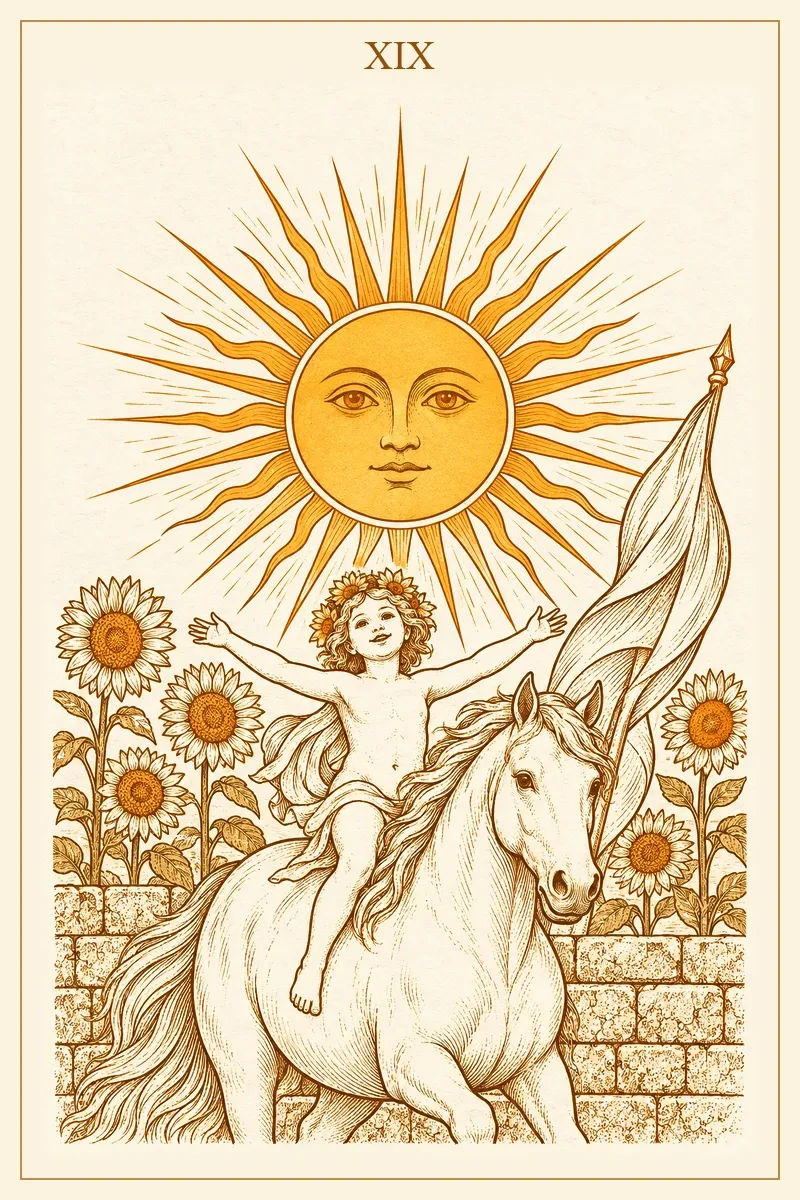
The Sun finishes the sunrise the Ten only begins. A child rides a white horse with arms flung wide beneath a full, smiling sun; beside the figure on the sand, the pairing says warmth and confidence will return once the worst has passed. The Sun's meaning of joy and vitality describes where this story is heading, though it rarely gets there overnight.
With The Fool: starting from nothing
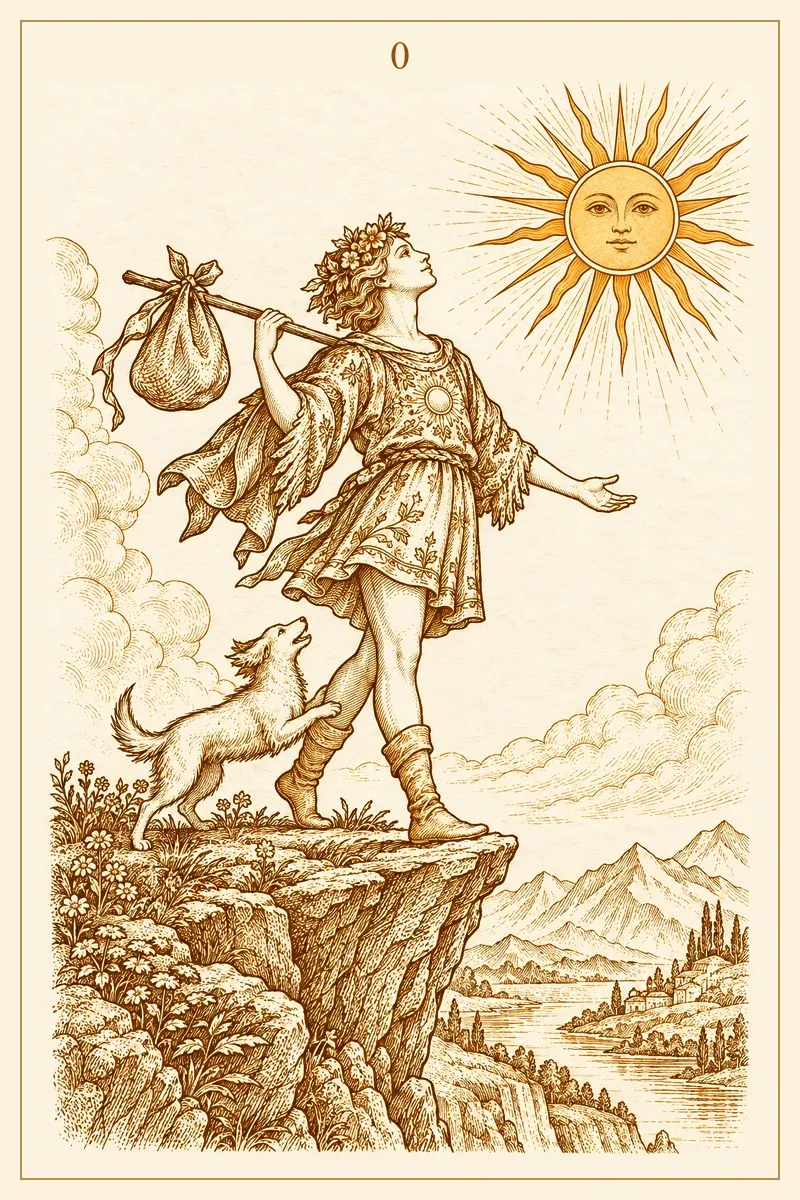
The Fool walks toward a cliff edge with a small bundle on a stick and a dog jumping at its side. After the Ten, it describes a fresh start made possible because there is nothing left to protect. The Fool's leap into the unknown suits this pairing: light luggage, open hands, curiosity in place of dread.
With Death: the ending is complete
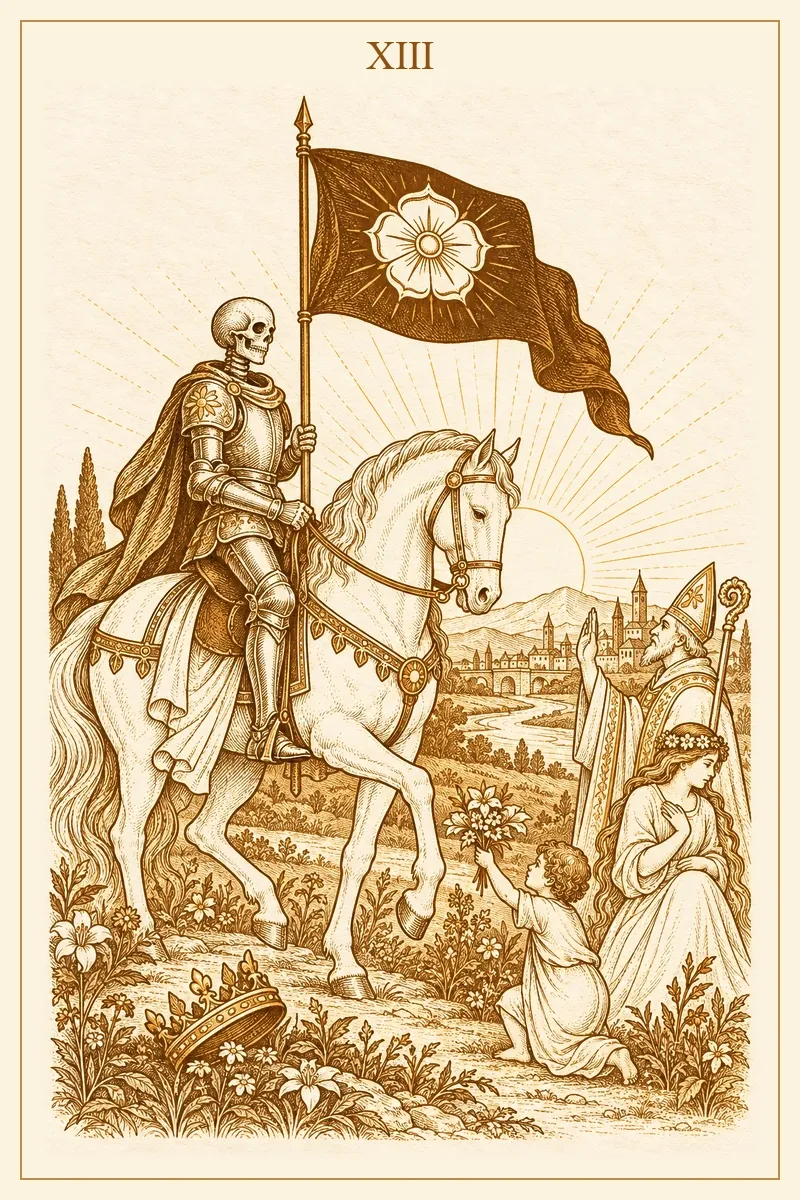
Death confirms that the ending is total and the old form will not return. In its picture, a skeleton rider in armor on a white horse moves past a fallen crown while a child holds out flowers. Together the two cards ask for full release, and the Death card's guide to endings and rebirth explains why that card clears ground rather than leaving it bare.
With The Star: healing after the wreck
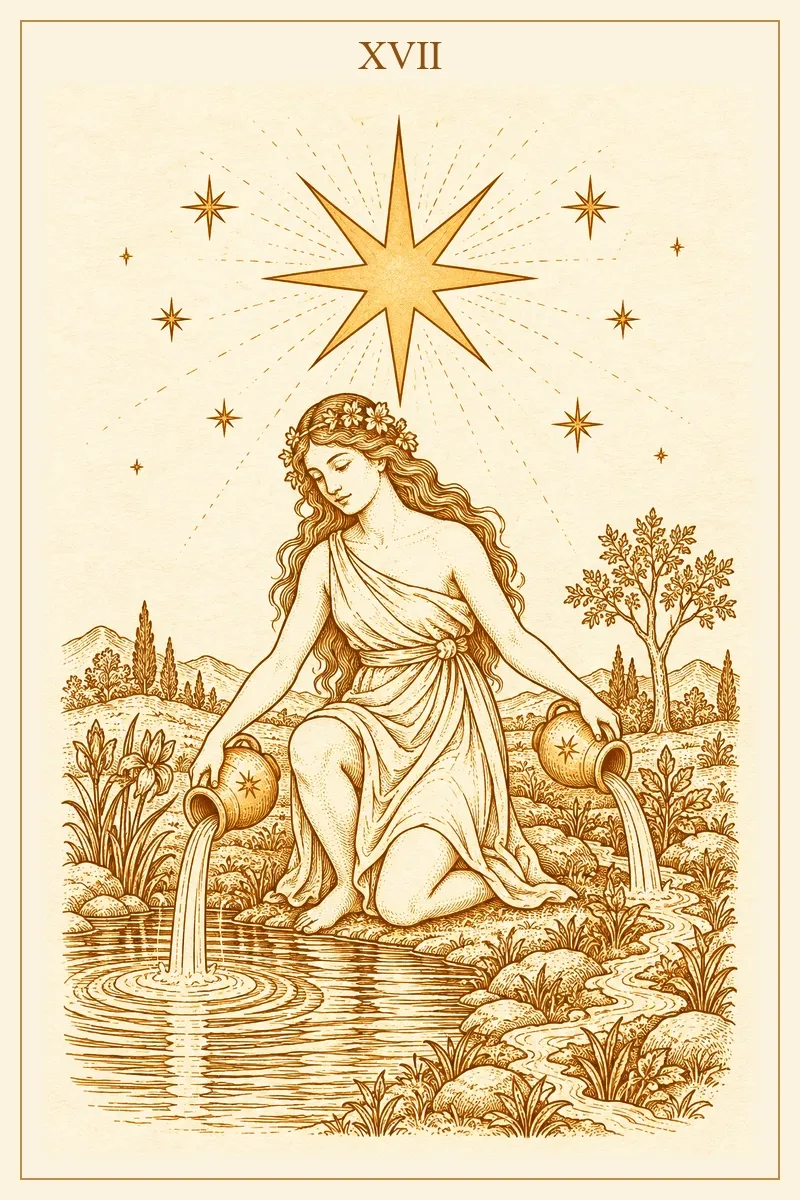
The Star is one of the gentlest partners the Ten can have. A kneeling woman pours water from two jugs, one into a pool and one onto the land, beneath a large eight-pointed star. Beside the Ten, it shows healing that is slow, steady and real, and The Star's message of hope and renewal is the kind of medicine this ending needs.
With the Ace of Swords: one clear blade after ten
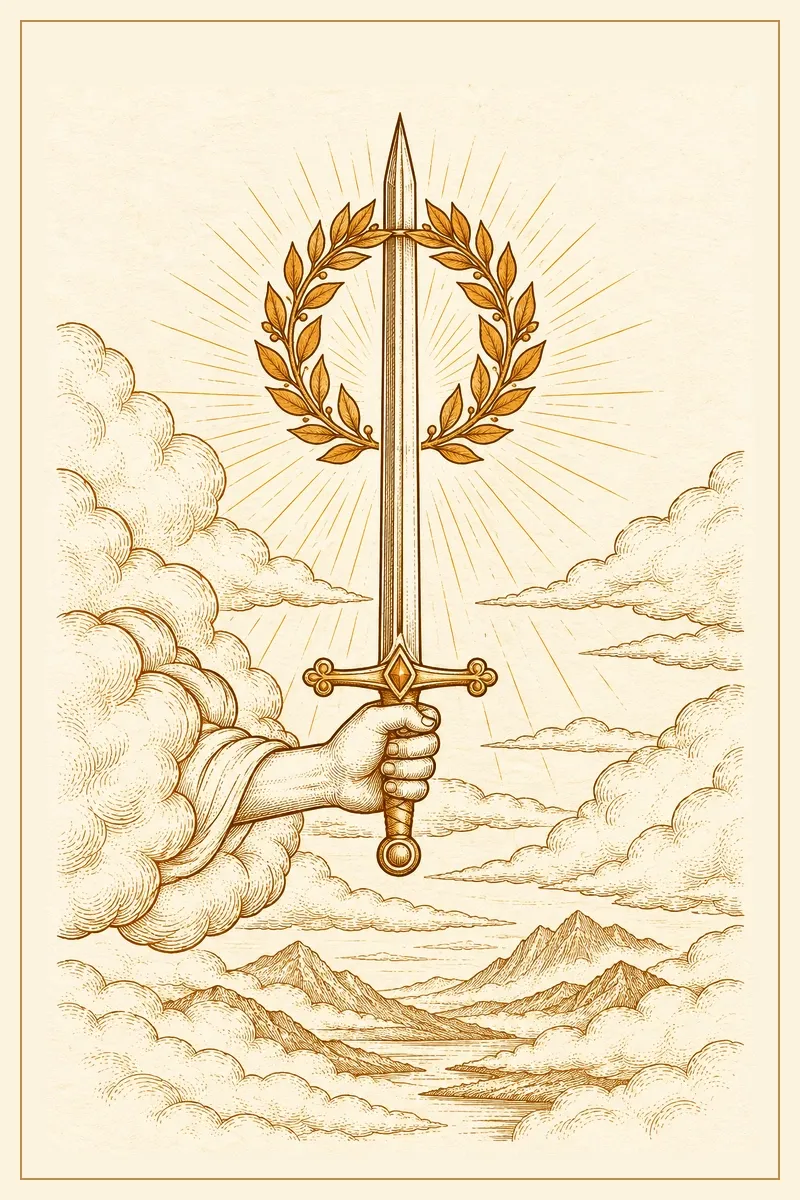
The Ace of Swords shows a hand from a cloud raising a single upright sword through a laurel wreath. Next to the Ten, one sword replaces ten: a single clear thought after the noise, a truth that lets you begin again. The Ace of Swords and its breakthroughs describes that clarity, and because Tens lead back to Aces, the two cards together hold the whole cycle of the suit.
The shoreline spread: five cards for the morning after
This spread follows the card's picture from the fallen figure to the sunrise. Set out five cards in a line, the first on the left, and read toward the dawn.
- The figure on the sand: what has ended.
- The ten swords: what made the ending hurt so much, including thoughts you may be adding.
- The ground underneath: what is still solid and holding you up.
- The half sun: the first sign of a new day that is already present.
- Standing up: one step toward getting back on your feet.
A sample reading: the bakery that closed
An illustrative question: "My sister and I closed the bakery we ran together for four years. How do I get through this?"
The figure on the sand: Ten of Wands. What ended was not only a shop but years of carrying too much: early mornings, every role at once, no days off.
The ten swords: Three of Swords. The sharpest pain is not the lost income but the hard words the sisters said to each other in the final months.
The ground underneath: Nine of Pentacles. Skill, some savings and a quiet ability to stand on one's own are intact.
The half sun: Six of Cups. The first light is here: the sisters have started swapping old recipes and childhood stories again.
Standing up: Knight of Pentacles. A slow, steady step, perhaps a monthly market stall rather than a new shop, at a pace the body can sustain.
Reading the five cards together
Read as one story, the closing ended a load carried for too long, and the deepest hurt lives between the sisters, not in the accounts. Skill and self-reliance remain, a shared memory is already softening the quarrel, and the next step is small. Read this way, the spread shows the same loss from the side of the sunrise.
Small steps for getting up again
- Say what ended, in one sentence. "The bakery closed" instead of "my life fell apart" already removes a few swords.
- Count the swords. List the thoughts attached to the ending and mark which are facts and which are fears.
- Lie still on purpose. Plan rest the way you would plan work; the figure's first job is to recover.
- Look for the half sun. Name one thing that is already slightly better than it was at the worst point.
- Tell someone you trust. Saying it aloud to a friend, a counselor or a support group is often when getting up begins.
Then sit with two questions: what is truly finished, and which of the ten swords are yours to pull out?
Frequently asked questions
Is the Ten of Swords the worst card in tarot?
It is one of the heaviest pictures in the deck, but it is not a curse. It describes an ending that has already happened, so the waiting is over and the sun is on the horizon.
What does the Ten of Swords mean reversed?
Most often recovery: getting back up after a painful ending. It can also mean resisting an ending that has already happened, or replaying the collapse in your mind. Neighboring cards and an honest look at your own energy help you tell which.
What does the Ten of Swords say about how someone feels about me?
Asked about another person's feelings, the card often describes exhaustion, hurt or a sense that something between you has ended. A spread cannot read someone's mind, fix a date or guarantee how things turn out, so treat this as one pattern to set beside what that person actually says and does.
How is the Ten of Swords different from the Three of Swords and The Tower?
The Three of Swords is the moment of heartbreak; the Ten is the end point, after the whole story has played out. The Tower is a sudden shock that knocks a structure down, while the Ten is lying in the aftermath. In short, the Tower falls and the Ten has landed.
What is the astrology of the Ten of Swords?
The Sun in Gemini, the third decan of Gemini, under the Air element. The Golden Dawn named it Lord of Ruin, and as a Ten it belongs to Malkuth, the sphere of completion.
When the sun is on the horizon
If something in your life has just come to its end and you would like a quiet way to look at what remains, you can start a tarot reading with Veil Soul and let the cards show you the morning.