
Building Intuition for Tarot Reading: A Practical Guide
Veil Soul
Published on · 7 min read
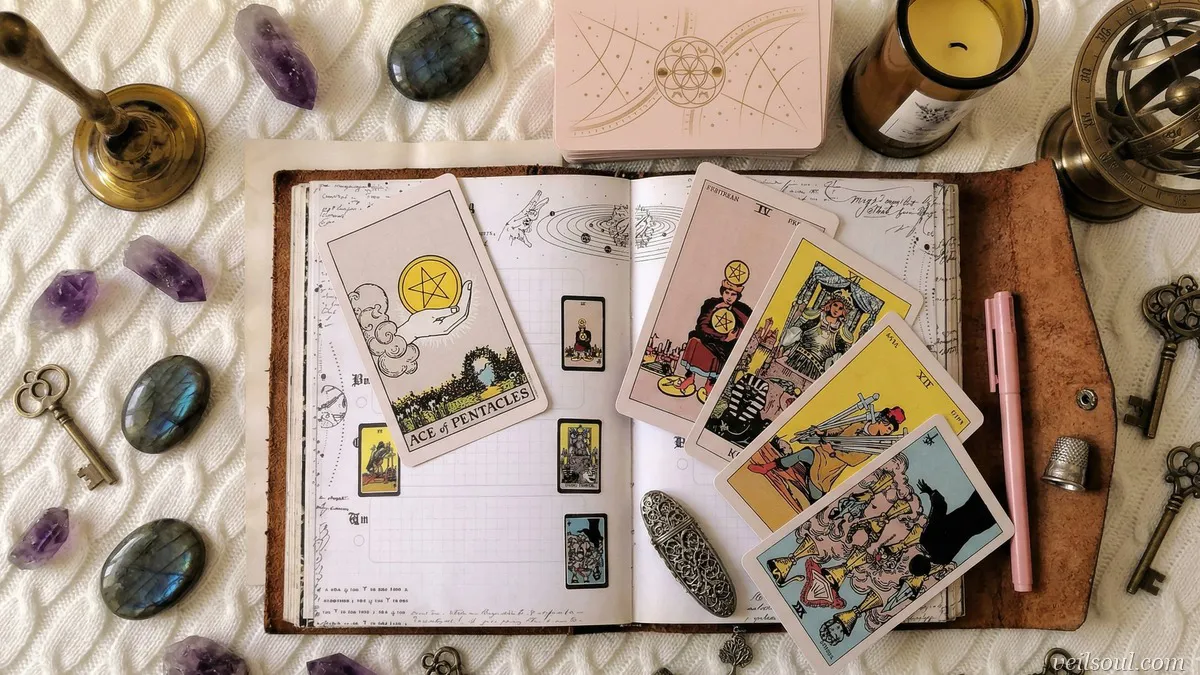
Every tarot reader eventually discovers that the most powerful readings come not from memorized meanings but from something quieter — an inner knowing that speaks through feelings, images, and sudden clarity. This is intuition, and the good news is that it's not a gift reserved for the few. Intuition is a skill, and like any skill, it can be developed through practice.
In this guide, we'll explore what tarot intuition actually is, why it matters more than memorization, and practical exercises you can use to strengthen it starting today.
What Is Tarot Intuition?
Tarot intuition is the ability to receive information from the cards that goes beyond their textbook meanings. It's the voice that says "this card feels heavy" before you know why. It's noticing that the figure in the card seems to be looking at the card next to it, creating a story you wouldn't find in any guidebook.
Intuition isn't mystical or supernatural — it's your brain processing information faster than your conscious mind can articulate. Your subconscious picks up patterns, makes connections, and delivers insights as "gut feelings." Tarot cards, with their rich symbolic imagery, are perfect triggers for this process.
Why Intuition Matters More Than Memorization
Learning the traditional meanings of 78 cards is valuable. But if you only read from memorized definitions, your readings will sound like a dictionary — accurate but lifeless. Intuition is what transforms a technical reading into a meaningful conversation.
- Memorization tells you: The Three of Swords means heartbreak and sorrow.
- Intuition tells you: This heartbreak is about something specific — the words left unsaid last Tuesday, the grief that hasn't been processed, the truth that the querent already knows but hasn't admitted.
The goal isn't to replace knowledge with intuition, but to let them work together. Knowledge provides the foundation; intuition provides the nuance.
Beginner Tip: If you're worried that you "don't have intuition," consider this: have you ever walked into a room and sensed the mood without anyone speaking? That's intuition. You already have it — tarot just gives it a structured language to speak through.
5 Daily Practices to Build Tarot Intuition
1. The Blind Card Pull
Each morning, shuffle your deck and pull a card without looking at it. Place it face-down. Before flipping it over, close your eyes and notice:
- What color comes to mind?
- What feeling do you get — light, heavy, warm, cold?
- Does a word or image flash in your mind?
Write these impressions down, then flip the card. Over time, you'll be amazed at how often your impressions align with the card's energy. This exercise trains your subconscious to communicate before your conscious mind takes over.
2. The 30-Second Gaze
Pull a card and set a timer for 30 seconds. Stare at the card without thinking about its meaning. Just look. Notice details you've never seen before — the expression on a face, the direction of the wind, the color of the sky, a small symbol in the corner.
After 30 seconds, write down three things you noticed for the first time. This practice trains your eye to see beyond the obvious and builds the observational skills that fuel intuitive reading.
3. Card Conversations
Choose any card and imagine it as a person sitting across from you. Ask it a question: "What do you want to tell me?" Then write whatever comes to mind — without editing, without judging, without trying to sound smart.
This exercise bypasses your analytical mind and lets your intuitive voice speak freely. The results can be surprisingly deep, even if they feel silly at first.
4. Body Scan Reading
After pulling a card, close your eyes and scan your body from head to toe. Where do you feel a response? A tightness in your chest? Warmth in your hands? A flutter in your stomach? A heaviness in your shoulders?
Your body processes emotional information faster than your mind. Learning to listen to physical responses gives you a second channel of intuitive data during readings.
5. Dream Journaling
Before sleep, place a tarot card under your pillow or on your nightstand. Ask your subconscious to show you something about this card in your dreams. Keep a notebook by your bed and write down any dreams or fragments immediately upon waking.
Even if the connection isn't obvious, this practice strengthens the bridge between your conscious and subconscious mind — the same bridge that intuition crosses during readings.
Mindset Shifts That Unlock Intuition
Trust Your First Impression
Your first impression of a card — before analysis kicks in — is almost always your most intuitive response. Train yourself to notice and honor it, even if it doesn't match the textbook meaning. You can always layer in traditional meanings afterward.
Embrace "I Don't Know"
Intuition often arrives as a vague sense rather than a clear sentence. Instead of forcing clarity, sit with uncertainty. Say "I'm not sure what this means yet" and keep observing. Intuition deepens when you stop demanding immediate answers.
Let Go of Being "Right"
The fear of being wrong is the single biggest intuition killer. When you're worried about accuracy, you retreat into safe, memorized meanings. Give yourself permission to be wrong. Intuitive skills develop through experimentation — some hits, some misses, all learning.
Stop Comparing
Your intuition speaks in your language, not someone else's. Some people see vivid images. Others feel emotions. Some hear words. Some just "know." There's no superior mode. Notice how your intuition communicates and work with that channel rather than trying to develop someone else's.
Beginner Tip: Keep an "intuition hits" journal. Whenever your intuitive impression is later confirmed — by the reading, by events, or by the querent — write it down. This record builds confidence and teaches you which of your intuitive signals are most reliable.
Intuition Exercises for Your Readings
Before the Reading
- Take three slow breaths to shift from analytical to receptive mode.
- Silently state your intention: "I am open to receiving clear guidance."
- Notice your emotional state. Are you calm, anxious, excited? Awareness of your own energy prevents it from contaminating the reading.
During the Reading
- Look at each card for at least 10 seconds before speaking or interpreting.
- Notice which card your eye is drawn to first — there's usually a reason.
- If a card triggers a random memory, thought, or image, say it out loud (or write it down). These "random" associations are often your intuition at work.
- Pay attention to the spaces between cards. Does the story flow? Where does it snag?
After the Reading
- Sit quietly for a moment. Does a final thought or feeling arise? This "afterecho" can be the most intuitive part of the reading.
- Record what came from memorization vs. what came from intuition. Over time, notice which insights proved most useful.
When Intuition Is Quiet
Some days your intuition will be loud and clear. Other days it will feel absent. This is normal. Intuition fluctuates with your energy, stress levels, sleep, and emotional state.
On quiet days:
- Rely more on traditional meanings — they're your safety net.
- Do a shorter reading or just a single card pull.
- Don't force it. A reading done with patience and textbook knowledge is still valuable.
- Rest and try again tomorrow. Intuition returns with renewal.
The Long Game
Building tarot intuition is a gradual process. You won't wake up one day with psychic powers. But over weeks and months of daily practice, you'll notice something shifting: the cards will start speaking to you in a personal language. You'll know things about a reading that you can't explain logically. You'll trust yourself more.
That trust — earned through practice, tested through experience, and deepened through patience — is what separates a card reader from a tarot reader.
Your Next Step: Start putting your developing intuition into practice with self-reading techniques, or learn about common beginner mistakes to avoid the pitfalls that can block intuitive development.
chat_bubble 0 Comments
Leave a Comment