Court Cards in Tarot: Understanding Pages, Knights, Queens, and Kings
Veil Soul
Published on · 7 min read
Why Court Cards Confuse Everyone
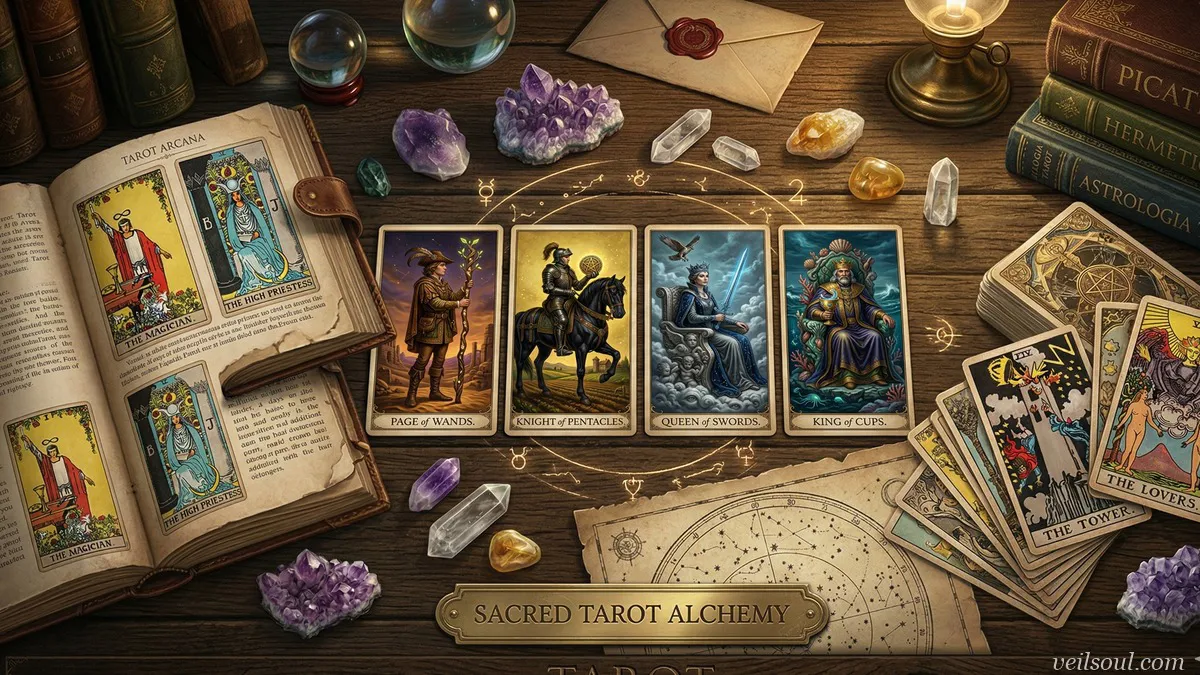
If there's one group of cards that stumps both beginners and experienced readers alike, it's the court cards. The 16 court cards — four in each suit (Pages, Knights, Queens, Kings) — are consistently voted the most difficult cards to interpret, and for good reason: they can represent actual people, personality traits, roles you're playing, energies you need to embody, or stages of development. That's a lot of possibility for a single card.
The good news: once you understand the system behind court cards, they become some of the most nuanced and insightful cards in your deck. This guide will give you that system.
The Court Card System
Every court card sits at the intersection of two qualities: a rank (Page, Knight, Queen, King) and a suit (Wands, Cups, Swords, Pentacles). The rank tells you how the energy expresses. The suit tells you what kind of energy it is.
The Four Ranks
Pages: The Students
Pages represent beginnings, curiosity, and youthful energy. They are the students of their suit — eager, sometimes naive, always learning. When a Page appears, it often signals:
- A new beginning in the suit's domain
- A message or piece of news arriving
- A young person or someone with beginner energy
- An invitation to approach something with fresh eyes and curiosity
Energy: Enthusiastic, open, inexperienced, potential-filled.
Knights: The Seekers
Knights represent action, pursuit, and extremes. They are the suit's energy in motion — passionate, sometimes reckless, always moving toward something. When a Knight appears:
- Action is being taken (or needs to be taken)
- Someone is pursuing a goal with intensity
- The suit's energy is expressed in its most extreme form
- Change, movement, or a journey is underway
Energy: Dynamic, driven, sometimes excessive, highly focused.
Queens: The Nurturers
Queens represent mastery through receptivity, inner power, and emotional intelligence. They have fully internalized their suit's energy and express it through influence rather than force. When a Queen appears:
- Emotional maturity and wisdom are present or needed
- Someone embodies their suit's energy with grace and depth
- Nurturing, creating, or holding space is the theme
- Inner authority and intuitive knowledge are highlighted
Energy: Receptive, powerful, emotionally intelligent, nurturing.
Kings: The Leaders
Kings represent mastery through authority, external power, and decisive action. They are the suit's energy fully realized and expressed outward — leadership, control, and responsibility. When a King appears:
- Authority, leadership, or expertise is present or needed
- Someone has mastered their suit's domain
- Decision-making, structure, and responsibility are themes
- External achievement and worldly competence are highlighted
Energy: Authoritative, experienced, decisive, outwardly expressive.
The Four Suits Applied to Court Cards
| Suit | Domain | Page | Knight | Queen | King |
|---|---|---|---|---|---|
| Wands | Passion, creativity, ambition | Creative spark, new inspiration | Passionate pursuit, bold action | Charismatic warmth, creative mastery | Visionary leadership, entrepreneurial drive |
| Cups | Emotions, relationships, intuition | Emotional openness, new feelings | Romantic pursuit, emotional idealism | Empathic depth, emotional wisdom | Emotional maturity, compassionate authority |
| Swords | Intellect, communication, truth | New ideas, intellectual curiosity | Swift action, sharp communication | Clear perception, independent thought | Intellectual authority, fair judgment |
| Pentacles | Material world, health, practical matters | New skills, practical learning | Steady progress, methodical work | Abundant nurturing, practical wisdom | Financial mastery, material success |
Three Ways to Read Court Cards
1. As People
The most traditional interpretation. Court cards can represent specific people in the querent's life — or the querent themselves. Clues to identification:
- Suit: Matches the person's dominant energy or zodiac element (Wands = Fire signs, Cups = Water signs, Swords = Air signs, Pentacles = Earth signs).
- Rank: Can indicate age or maturity — Pages for young or inexperienced people, Kings/Queens for mature or authoritative figures. However, a 60-year-old learning something new might appear as a Page.
- Context: The question asked and surrounding cards help clarify who the court card represents.
2. As Energies
Rather than representing a specific person, the court card represents an energy to embody. The Queen of Swords in an advice position doesn't mean "find a Queen of Swords person" — it means "approach this situation with clear thinking, emotional detachment, and honest communication."
This interpretation is often the most useful, especially for self-readings.
3. As Developmental Stages
The four ranks can represent stages in mastering any skill or area of life:
- Page: Discovery — "I'm curious about this."
- Knight: Pursuit — "I'm actively chasing this."
- Queen: Integration — "I've internalized this wisdom."
- King: Mastery — "I lead and teach from this knowledge."
Quick Profiles: All 16 Court Cards
Wands Court
- Page of Wands: The adventurous spark. Excited about a new creative project or passion. Enthusiastic but untested.
- Knight of Wands: The bold charger. Pursuing a vision with fearless energy. May be impulsive or impatient.
- Queen of Wands: The magnetic leader. Confident, warm, and creatively powerful. Inspires others through presence alone.
- King of Wands: The visionary commander. Turns inspiration into empires. Natural leader who leads by example and charisma.
Cups Court
- Page of Cups: The gentle dreamer. Open to new emotions, creative inspiration, or a sweet message. Innocent and imaginative.
- Knight of Cups: The romantic idealist. Follows the heart above all else. Charming, poetic, sometimes impractical.
- Queen of Cups: The empathic healer. Deeply intuitive, emotionally wise, and compassionate without losing herself. The best listener in the deck.
- King of Cups: The calm anchor. Emotionally mature and stable, able to navigate turbulent feelings with grace. A counselor and mediator.
Swords Court
- Page of Swords: The keen observer. Intellectually curious, eager to learn, and sometimes too clever for their own good. Asks uncomfortable questions.
- Knight of Swords: The swift striker. Charges into situations with intellectual force. Brilliant but may cut others with harsh truths.
- Queen of Swords: The truth-teller. Perceptive, independent, and unafraid of difficult conversations. Compassion tempered by clarity.
- King of Swords: The fair judge. Makes decisions based on logic and ethics. An authority who values truth above comfort.
Pentacles Court
- Page of Pentacles: The diligent student. Focused on learning a new skill or starting a practical venture. Patient and methodical.
- Knight of Pentacles: The steady worker. Makes progress through consistent, reliable effort. Not flashy but deeply effective.
- Queen of Pentacles: The abundant provider. Creates comfort, security, and warmth. Practically wise and deeply generous.
- King of Pentacles: The wealthy builder. Financial success, material mastery, and the wisdom to enjoy abundance responsibly.
Tips for Reading Court Cards Confidently
- Ask "who or what?": When a court card appears, ask: Is this a person? An energy? A role? Let the surrounding cards and your intuition guide you.
- Don't force gender: Queens can represent men. Kings can represent women. The rank describes energy, not biology.
- Notice clusters: Multiple court cards in a spread suggest that interpersonal dynamics are central to the question.
- Use them for daily practice: Pull a court card in your daily draw and ask: "What energy do I need to embody today?" This is one of the fastest ways to internalize court card meanings.
- Build personal associations: Assign real people in your life to court cards. "My boss is the King of Pentacles. My best friend is the Queen of Cups." These personal connections make court cards come alive in readings.
The court card secret: Stop trying to memorize what each court card "means" and start asking what each card feels like. When you can sense the difference between a Queen of Wands and a Queen of Cups — the warmth versus the depth, the fire versus the water — you'll never struggle with court cards again.
chat_bubble 0 Comments
Leave a Comment