Tarot Reversals: To Read or Not to Read?
Veil Soul
Published on · 7 min read
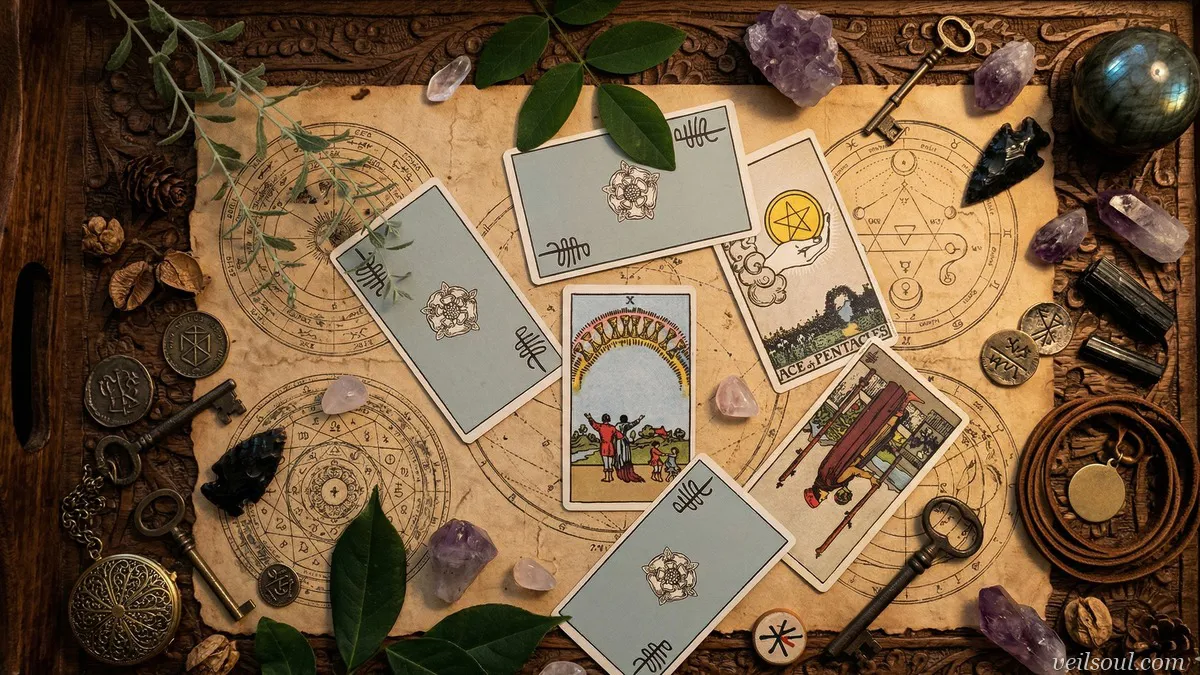
Sooner or later, every tarot reader faces this question: what do you do when a card lands upside-down? Reversed cards — also called inverted or ill-dignified cards — are one of the most debated topics in tarot. Some readers consider them essential. Others ignore them entirely. Neither approach is wrong, but understanding your options helps you make an intentional choice.
In this guide, we'll explore what reversals are, the most popular ways to interpret them, and how to decide whether they belong in your practice.
What Are Tarot Reversals?
A reversal simply means a card appears upside-down when you draw it. This can happen naturally during shuffling — especially with the messy pile (wash) shuffle method — or you can intentionally rotate some cards before shuffling to introduce reversals into your deck.
Historically, reversals have been part of tarot reading since at least the 18th century. The Rider-Waite-Smith guidebook included reversed meanings for all 78 cards. But many respected readers and traditions work exclusively with upright cards.
Why Some Readers Use Reversals
Expanded Vocabulary
Without reversals, you have 78 possible messages. With reversals, you have 156. This expanded vocabulary allows for more nuance — a reversed card can indicate a blocked, internalized, or shadow version of the card's energy that the upright version alone might not convey.
Acknowledging Shadow Energy
Every card has a spectrum of expression, from its highest potential to its most challenging manifestation. Reversals give you a built-in mechanism for accessing the shadow side. For example:
- The Sun upright: Joy, success, vitality
- The Sun reversed: Dimmed joy, setbacks, inner child needing attention
Emotional Texture
Reversals add emotional texture to a reading. A spread full of upright cards feels different from one with several reversals mixed in. The reversals draw your eye and demand extra attention — often highlighting exactly where the tension or growth opportunity lies.
Why Some Readers Don't Use Reversals
Each Card Already Contains Its Shadow
Many readers argue that every upright card already contains its full range of meaning — positive, negative, and everything in between. The Ten of Swords upright is already challenging enough without needing a reversal to convey difficulty. Context, position, and surrounding cards provide all the nuance needed.
Simplicity and Flow
For beginners especially, learning 78 upright meanings is already a significant undertaking. Adding 78 reversed meanings doubles the workload and can overwhelm new readers, leading to analysis paralysis during readings.
Reading Style
Some readers work primarily with imagery and intuition rather than memorized meanings. For them, an upside-down image is simply harder to read visually, which disrupts the intuitive flow rather than enhancing it.
Beginner Tip: If you're just starting out, consider reading with upright cards only for your first few months. Get comfortable with the 78 basic meanings first. You can always add reversals later — it's not a now-or-never decision.
5 Ways to Interpret Reversed Cards
If you do choose to read reversals, there are several interpretation approaches. You don't have to pick just one — many experienced readers blend these methods depending on the reading.
1. Blocked or Delayed Energy
The most common interpretation: the card's energy is present but stuck, blocked, or not yet fully manifesting. Think of it as the upright meaning trying to come through but encountering resistance.
- Ace of Cups reversed: Love is available but you're not open to receiving it yet.
- Three of Pentacles reversed: Collaboration is needed but communication isn't flowing.
2. Internal vs. External
Upright cards represent external, visible energy. Reversed cards represent the same energy turned inward — private, internal, or not yet expressed.
- Queen of Wands upright: Outward confidence and charisma.
- Queen of Wands reversed: Inner confidence building quietly, not yet expressed to the world.
3. Weakened or Excessive Energy
The reversal indicates either too little or too much of the card's energy. Context determines which interpretation fits:
- Knight of Swords reversed (deficient): Lacking assertiveness, avoiding necessary confrontation.
- Knight of Swords reversed (excessive): Being recklessly aggressive, all charge and no strategy.
4. Shadow Side or Warning
The reversal highlights the card's negative potential — the shadow expression that emerges when the energy goes off-balance.
- The Emperor reversed: Tyranny, rigidity, abuse of authority (shadow of healthy structure).
- Six of Cups reversed: Being trapped in the past, unhealthy nostalgia (shadow of sweet memories).
5. Release or Turning Point
The reversed card indicates energy that is moving away, releasing, or turning around. Something is ending or transforming.
- Five of Cups reversed: The grieving period is ending; you're ready to see what remains rather than what was lost.
- Eight of Swords reversed: The mental prison is dissolving; freedom and clarity are returning.
How to Decide: Reversals or Not?
There's no objectively correct answer. Here are some questions to guide your decision:
- How do you learn best? If you're a "more information is better" person, reversals may energize your practice. If you prefer simplicity and depth over breadth, upright-only may suit you better.
- What's your reading style? If you rely heavily on card imagery and storytelling, upside-down images may feel disruptive. If you work more with keywords and energy, reversals add useful data.
- How experienced are you? Beginners benefit from mastering upright meanings first. Once those feel solid, reversals can be introduced gradually.
- What deck are you using? Some decks (like the Thoth Tarot) are designed to be read without reversals. Others (like Rider-Waite-Smith) include reversed meanings by design.
Beginner Tip: You can experiment without commitment. Try reading with reversals for a week, then without for a week. Notice which approach produces readings that feel more helpful and clear. Your practice, your rules.
Practical Tips for Working with Reversals
If you decide to include reversals in your practice:
- Shuffle intentionally: Use the messy pile shuffle to naturally introduce reversals, or rotate half the deck 180 degrees before shuffling.
- Start with one method: Choose one interpretation approach (blocked energy is the easiest to start with) and use it consistently for at least a month before trying others.
- Don't panic at many reversals: A reading full of reversed cards doesn't mean everything is terrible. It often means the energy is internal, developing, or in a state of transition.
- Journal reversed cards separately: Track which cards you frequently draw reversed and notice patterns. Certain cards may carry different weight for you in reversal than in the upright position.
The Middle Path: Selective Reversals
Some readers take a middle approach — they read all cards upright by default but pay special attention when a reversal appears naturally (a card that flips during shuffling). This way, reversals become rare, attention-grabbing signals rather than a standard part of every reading.
This is a perfectly valid approach and one that many experienced readers settle into over time.
Your Practice, Your Choice
Tarot is a personal practice. There is no authority who can tell you the "right" way to handle reversals. What matters is that your choice is intentional — that you've thought about it, tried different approaches, and settled on what serves your readings best.
And remember: you can always change your mind. Many readers go through phases — using reversals for a while, then dropping them, then picking them back up. Your practice is alive and evolving, just like you.
Your Next Step: Ready to strengthen your card-reading instincts? Learn about building intuition for tarot reading, or explore how to read tarot for yourself to put these reversal skills into practice.
chat_bubble 0 Comments
Leave a Comment