
Creating Your Tarot Reading Space: A Guide to Sacred Setup
Veil Soul
Published on · 6 min read
Why Space Matters
You can read Tarot anywhere — on a park bench, at your kitchen table, on your bedroom floor at midnight. The cards don't require a particular setting to work. But creating a dedicated reading space, even a simple one, does something powerful: it signals to your mind that it's time to shift gears. Just as a meditation cushion tells your brain "we're meditating now," a reading space tells your brain "we're listening to the cards now."
This isn't about superstition or aesthetics (though beautiful spaces are lovely). It's about building intuition through consistent environmental cues. When you sit in the same space, with the same intentional setup, your mind learns to drop into receptive mode faster. Over time, simply entering your reading space can quiet the mental chatter and open the intuitive channels.
The Minimalist Setup: Start Here
You don't need an elaborate altar or a dedicated room. The minimum effective reading space requires only:
- A flat surface large enough to lay out a five-card spread — a desk, table, or even a large book on your lap.
- A reading cloth — any fabric that protects your cards and defines the reading area. A simple scarf, bandana, or piece of velvet works perfectly. The cloth creates a visual boundary that says "this is the reading space."
- Reasonable quiet — you don't need silence, but minimize interruptions. Phone on silent, notifications off.
That's it. Everything else is enhancement, not requirement.
Building Your Space: Layer by Layer
If you want to deepen your setup, add elements gradually. Each addition should feel meaningful to you, not obligatory.
Layer 1: Light
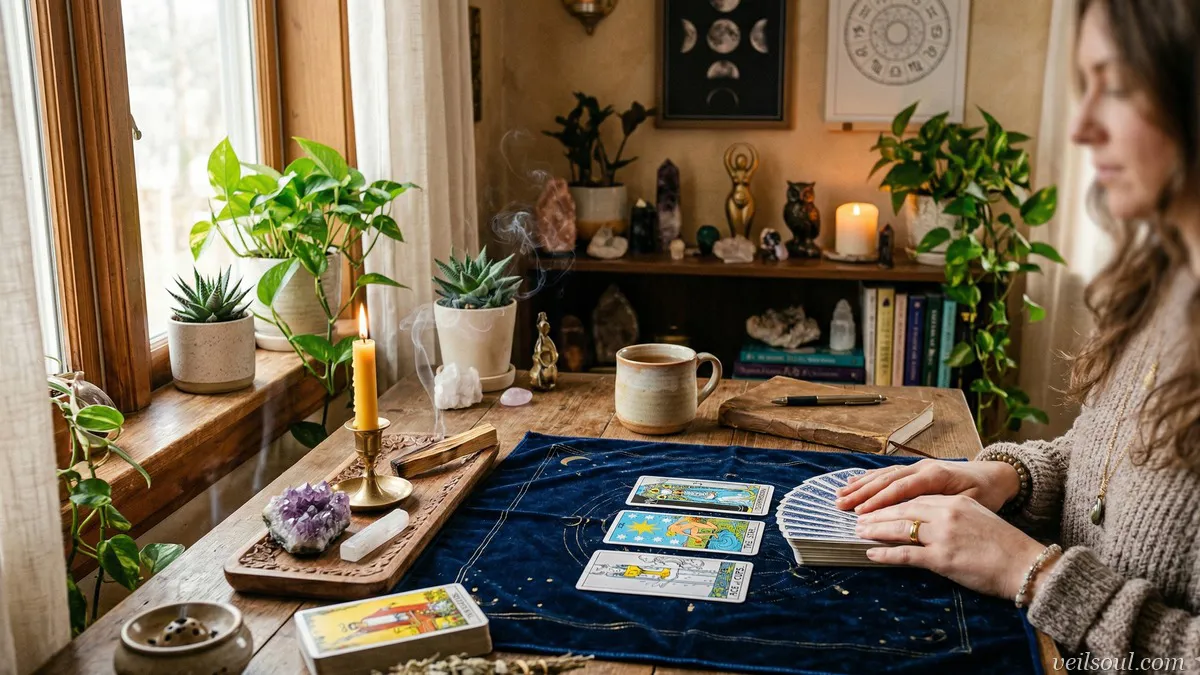
Lighting profoundly affects mood and focus. Harsh overhead lights keep your mind in "task mode." Softer, warmer light — a candle, a salt lamp, fairy lights, or a dimmed desk lamp — signals a shift toward contemplation. Many readers find that candlelight in particular helps them transition into an intuitive headspace.
Safety note: If you use candles, keep them clear of your cards and cloth. A battery-operated candle provides the same ambiance without the fire risk.
Layer 2: Scent
Scent is the sense most directly connected to memory and emotion. A consistent scent associated with your readings creates a powerful neural shortcut to your reading mindset. Options include:
- Incense: Traditional and atmospheric. Sandalwood, frankincense, and lavender are popular choices.
- Essential oils: A diffuser or a drop on your wrist. Less smoke, more control over intensity.
- Herbs: Dried rosemary, mugwort, or sage near your reading space.
Choose one scent and use it consistently. Over time, that scent alone will help you drop into reading mode.
Layer 3: Crystals and Objects
Many readers keep meaningful objects near their reading space — crystals, stones, statues, photographs, or natural elements like shells or feathers. These objects serve as focal points for intention and as anchors for your practice.
Common choices include:
- Clear quartz: Amplifies intention and clarity.
- Amethyst: Supports intuition and spiritual connection.
- Black tourmaline: Grounding and protective energy.
- Moonstone: Enhances intuitive receptivity.
These aren't required for good readings — they're tools for deepening your relationship with your practice. If crystals aren't your thing, a meaningful photograph, a small plant, or even a favorite mug can serve the same purpose.
Layer 4: Sound
Some readers prefer silence; others find that ambient sound helps them focus. If sound supports your practice, consider:
- Ambient music: Instrumental, low-tempo music without lyrics. Avoid anything that pulls your attention toward the music itself.
- Nature sounds: Rain, ocean waves, forest ambiance.
- Singing bowls or bells: A single tone at the beginning and end of a reading creates a clear container for the practice.
Designing for Different Living Situations
Small Spaces
If you live in a studio apartment or share a room, your reading space can be a portable kit: a cloth, a candle, your deck, and perhaps a small crystal, all stored in a box or pouch. When you set them up, you create a temporary sacred space. When you put them away, the space returns to its normal function. The ritual of setting up and taking down can itself become part of your practice.
Shared Spaces
If family members or roommates share your living area, establish a "reading time" agreement — even 15 minutes of uninterrupted space is enough. Alternatively, read in the early morning or late evening when the space is naturally quieter.
On the Go
For travel or outdoor readings, a small cloth and your deck are all you need. Parks, beaches, and quiet cafes can be beautiful reading spaces. The key is the intention you bring, not the physical setup.
The Reading Ritual
A simple ritual for entering your reading space transforms a casual card pull into a meaningful practice:
- Arrive. Sit down. Place your hands flat on the table. Feel the surface beneath your palms. You are here.
- Breathe. Three deep breaths. Each exhale releases something: the first releases the outside world, the second releases expectations, the third releases self-judgment.
- Open. Light your candle, set your cloth, bring out your deck. Each action is deliberate.
- Set intention. Silently or aloud: "I am open to what the cards want to show me. I receive with honesty and gratitude."
- Begin. Shuffle and draw.
This entire sequence takes less than two minutes. But those two minutes transform the quality of your readings.
Maintaining Your Space
- Keep it clean: A cluttered space creates a cluttered mind. Before each reading, clear away anything that doesn't belong.
- Refresh periodically: Change your cloth, rearrange your crystals, or add a new element when your practice feels stale. Small changes reinvigorate your connection to the space.
- Cleanse your deck regularly, especially if you're reading for others or after heavy emotional readings.
- Respect the boundary: Try not to use your reading space for other activities. If that's impossible (it often is), the ritual of setting up and taking down your reading materials maintains the psychological boundary.
What Your Space Doesn't Need
Resist the pressure to create an "Instagram-worthy" reading space. Your readings don't improve because your altar is photogenic. What matters is:
- Consistency: Same space, same setup, same ritual.
- Comfort: You should want to sit there.
- Intention: Every element should serve your practice, not your aesthetic.
A worn scarf on a cluttered desk, lit by a single candle, with a well-loved deck — this is a more powerful reading space than a gorgeous altar that you never actually use.
The truth about space: The most important reading space is the one inside your mind — the quiet, receptive, curious state where intuition lives. Everything external exists to support your arrival there. Start simple. Build gradually. Let your space grow with your practice.
chat_bubble 0 Comments
Leave a Comment