What Does It Mean When Your Tarot Reading Is All Swords?
Veil Soul
Published on · 10 min read
Key Takeaways
- An all-Swords reading indicates a situation dominated by mental energy — thoughts, communication, conflict, truth, and the painful clarity that comes from seeing things you can't unsee
- Swords represent the air element: intellect, analysis, communication, conflict, and truth. A reading full of Swords means you're in your head, and the way out isn't through more thinking
- The absence of other suits tells you what's missing: no Cups means emotions are being suppressed or intellectualized, no Pentacles means you're disconnected from practical reality, no Wands means passion and drive have been replaced by anxiety
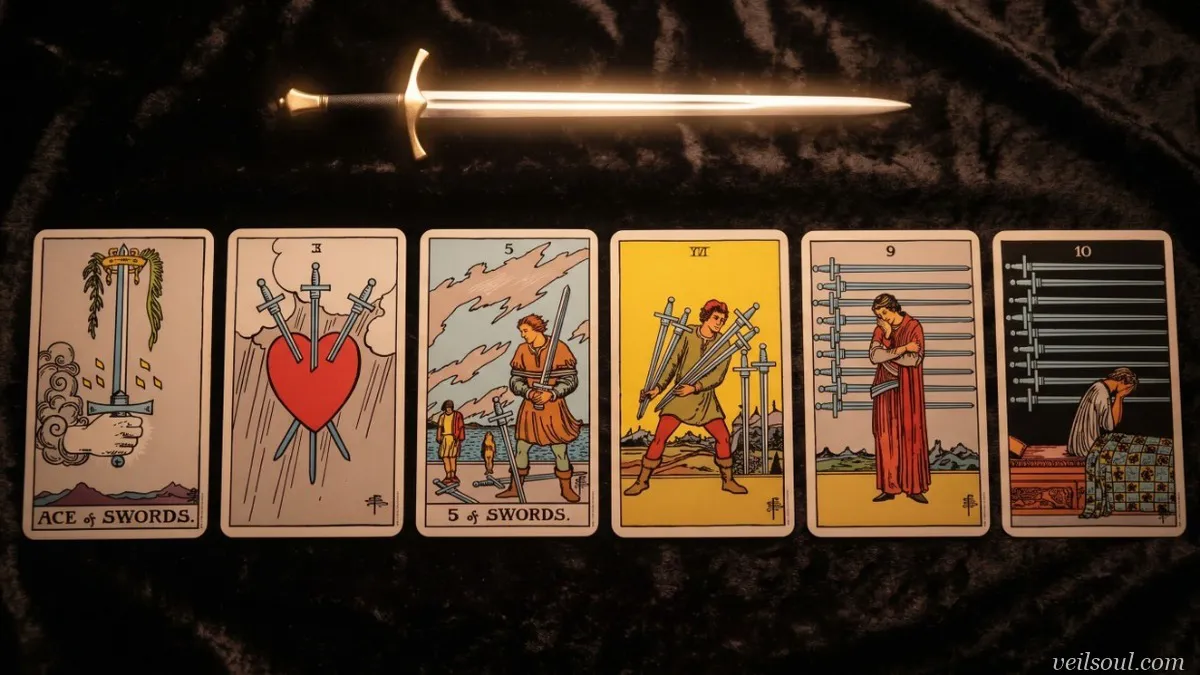
Every card is a blade. Three of Swords — heart pierced, rain falling. Eight of Swords — blindfolded, bound, surrounded by planted blades. Nine of Swords — sitting up in bed at 3 AM, nine blades mounted on the wall behind you like a collection of accumulated worries. Ten of Swords — face-down, ten blades in your back, dawn breaking on the horizon that you can't see because you're face-down. It's a brutal visual. And it's showing you something important.
An all-Swords reading is the tarot's way of saying: you're drowning in air. Your mind is running the show — analyzing, worrying, arguing, rehearsing conversations, constructing worst-case scenarios — and it's exhausting every other part of you. The Swords suit is the double-edged blade of intellect: it can cut through illusion and reveal truth, or it can turn inward and cut you to pieces. An all-Swords spread is telling you which one is happening right now.
The World of Swords
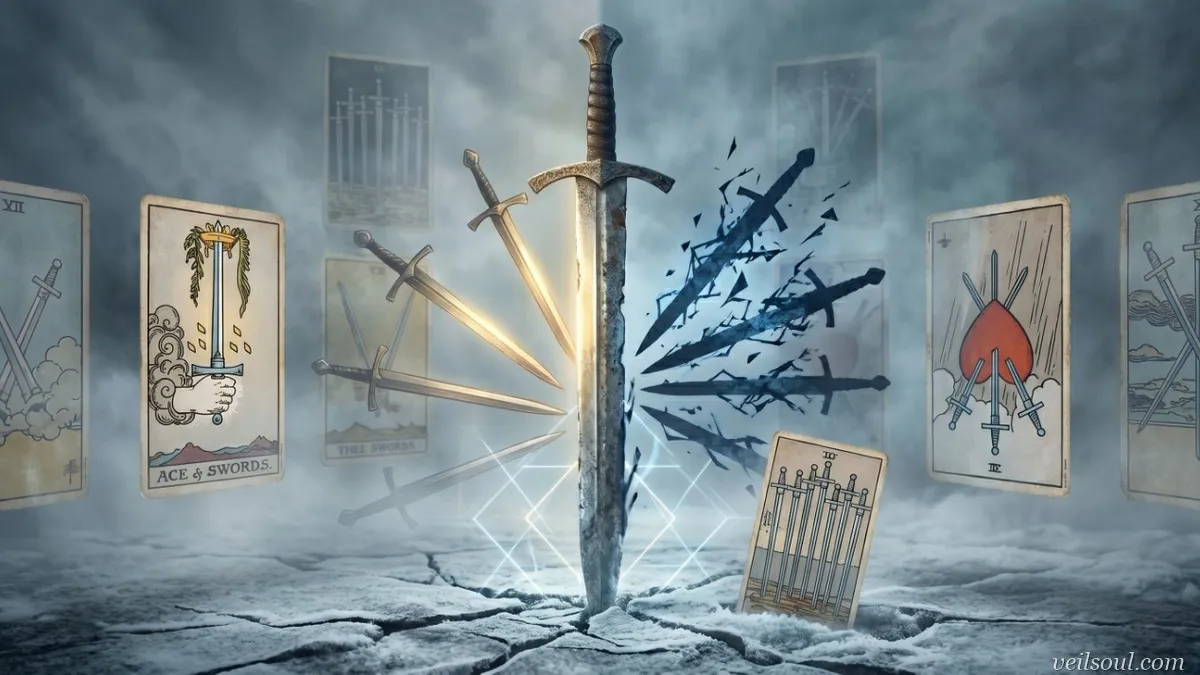
Swords correspond to the air element and govern the mind: thoughts, beliefs, communication, conflict, decision-making, truth, and — at their worst — anxiety, rumination, and cruelty.
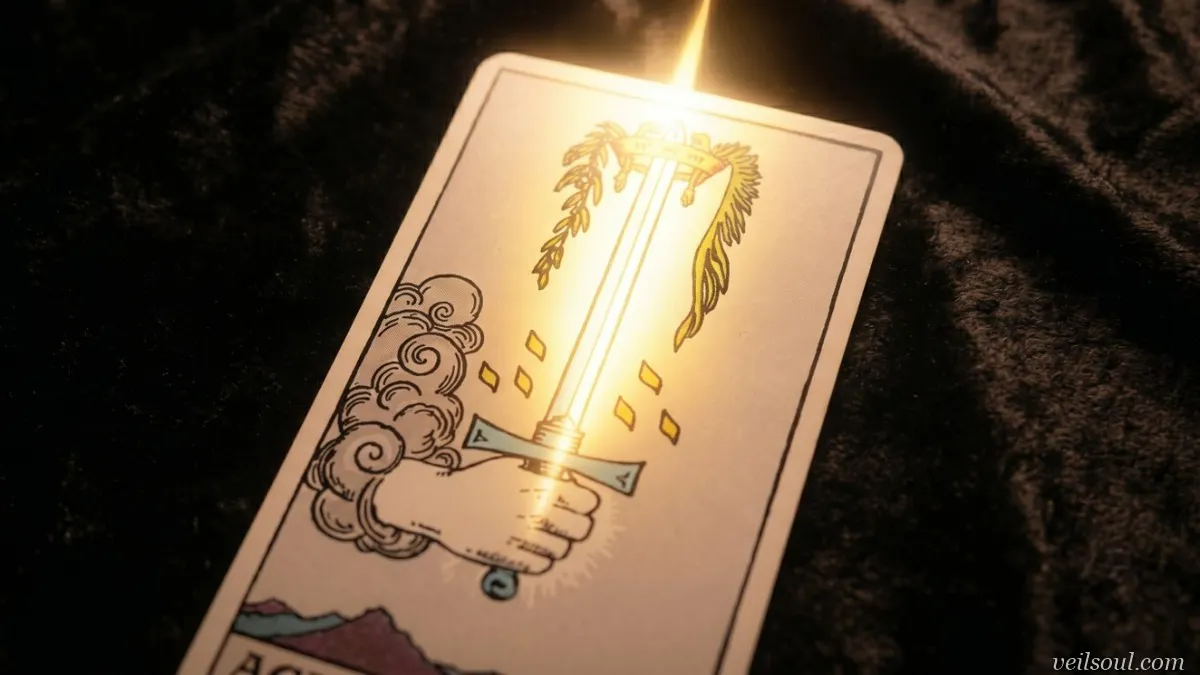
When every card in your spread is a Sword, you're operating entirely from the mental plane. This isn't inherently bad — Swords also represent clarity, discernment, justice, and the courage to face hard truths. Ace of Swords — a single blade piercing a crown through clouds — is one of the most powerful cards in the deck: breakthrough clarity, mental conquest, the moment the fog lifts and you see with devastating precision.
But an all-Swords reading is rarely all Aces. It's usually a mix of mental clarity and mental suffering — because the mind that sees everything clearly also has nowhere to hide from what it sees. Rachel Pollack described Swords as "the suit of necessary pain" — the pain of knowing, of seeing, of being unable to un-know what you've understood.
What the Missing Suits Tell You
In an all-Swords reading, the missing suits are your medicine — the elements that would balance the overwhelming air energy.
No Cups (Water): You've intellectualized your emotions. Instead of feeling grief, you're analyzing why you're grieving. Instead of experiencing love, you're evaluating whether the relationship meets your criteria. The head has colonized the heart's territory. Your medicine: stop thinking about your feelings and start feeling your feelings. Cry without understanding why. Laugh without examining the joke. Let emotion exist without mental commentary.
No Pentacles (Earth): You're disconnected from your body and the physical world. You're living entirely in thoughts, plans, and hypotheticals while neglecting sleep, food, movement, and tangible action. Your medicine: touch something real. Cook a meal. Walk barefoot on grass. Clean your apartment. Do one concrete physical thing that takes you out of your head and into your hands.
No Wands (Fire): Anxiety has replaced passion. The energy that should be driving you toward what you want has been hijacked by fear of what you don't want. You're spending all your mental fuel on defense instead of creation. Your medicine: do something — anything — creative or physical that generates heat rather than analysis. Dance badly. Write without editing. Start the project you've been planning to death.
"A lawyer. Of course it was a lawyer. She pulled six cards and they were all Swords. She laughed — the sharp, mirthless laugh of someone who's been using their intellect as both weapon and shield for so long they've forgotten any other mode. 'My whole life is Swords,' she said. 'Arguments by day, insomnia by night.' Nine of Swords sat at the center — the figure upright in darkness, head in hands, surrounded by blades of accumulated worry. 'When was the last time you did something that didn't require thinking?' I asked. She opened her mouth, closed it, and opened it again. 'I don't remember,' she said. 'That's the reading,' I told her. 'Not what the Swords mean. What their exclusive presence means. You've eliminated every other element from your life. No water — you don't let yourself feel. No earth — you don't ground yourself in anything tangible. No fire — your passion has been eaten by your anxiety.' She took a pottery class the following week. Her hands in clay for two hours. No thoughts required. She told me it was the first time she'd felt peace in months. The Swords hadn't told her anything she didn't know. They'd shown her, in the starkest possible way, what was missing."
How to Read an All-Swords Spread
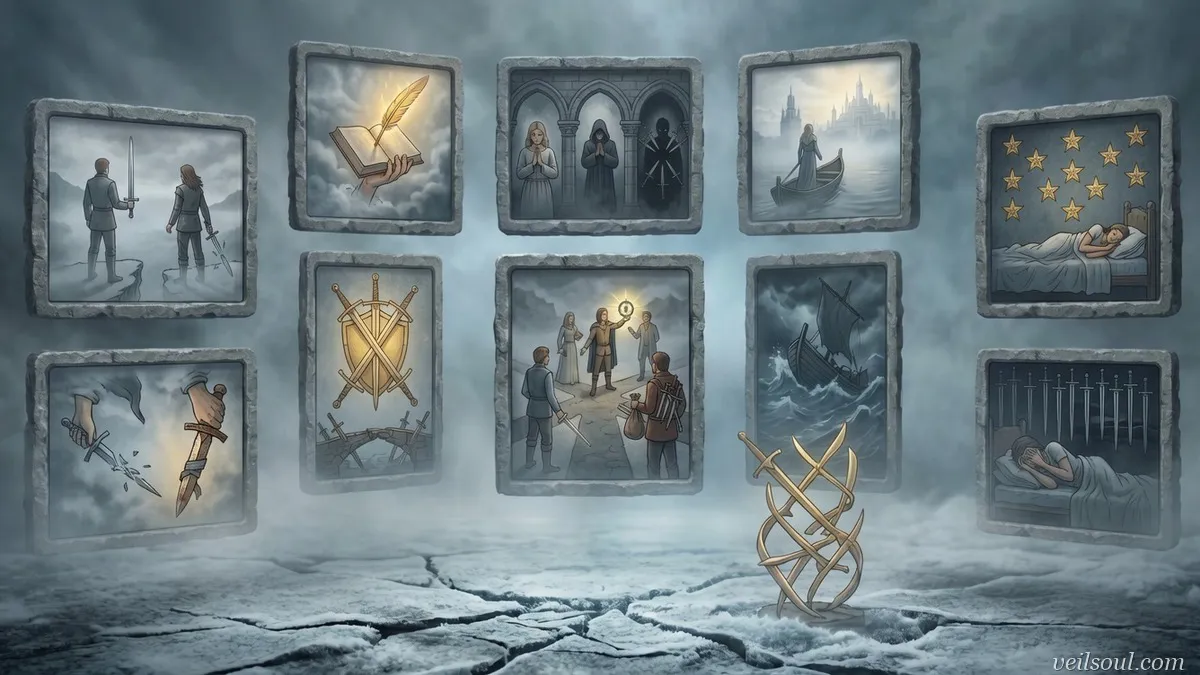
Follow the numbers. In an all-Swords spread, the numerical arc tells you where you are in the mental cycle.
Low Swords (Ace-Three): The mental situation is emerging. Ace of Swords = new clarity or new conflict arriving. Two of Swords = a decision being avoided, the blindfolded woman with crossed blades refusing to choose. Three of Swords = a painful truth that's just pierced through. You're at the beginning of a mental or communicative process.
Mid Swords (Four-Seven): The mental situation is developing and complex. Four of Swords = forced rest, the knight lying in recovery, stained glass light falling across his tomb. Five of Swords = conflict with a winner and losers, pyrrhic victory. Seven of Swords = deception or strategic retreat, the figure tiptoeing away with five of seven swords. You're in the messy middle of a mental challenge.
High Swords (Eight-Ten): The mental situation is reaching its conclusion — often painfully. Eight of Swords = feeling trapped by your own thoughts. Nine of Swords = anxiety at its peak. Ten of Swords = mental exhaustion, absolute bottom, the dawn breaking that you can't see from the ground. High Swords are intense but often mark turning points — the crisis that precedes clarity.
Court Swords: The Queen of Swords — that sharp, clear-eyed figure with raised blade — represents someone operating with intellectual precision and emotional clarity born from pain. She's the person in your life (or the part of you) who has been through the worst of the Swords and emerged sharper. Mary K. Greer called her "the widow" — someone who understands loss and uses that understanding as a lens for truth.
How to Get Out of Your Head
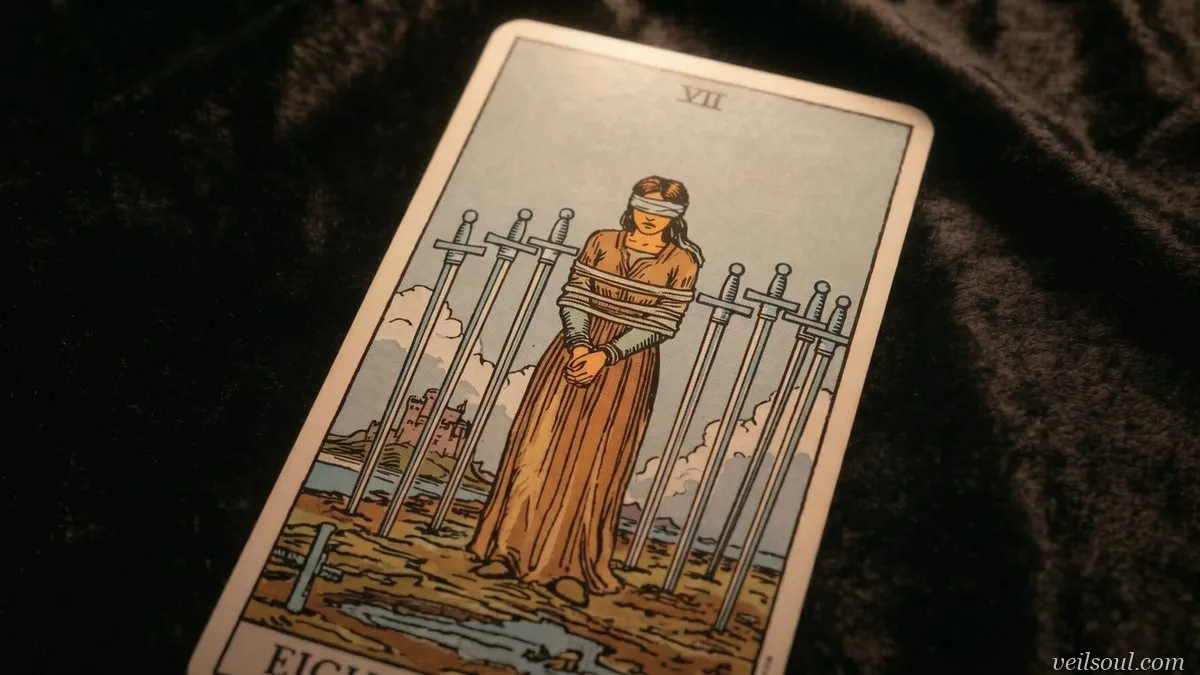
An all-Swords reading is both diagnosis and prescription. The diagnosis: you're overthinking. The prescription: stop.
"Stop overthinking" is terrible advice without a replacement behavior. Here's what actually works:
- Body-first activities. Exercise, cooking, gardening, sex, dancing, cleaning — anything that demands physical engagement and refuses to let the mind run commentary. The body is the Swords suit's natural antidote because physical sensation is pre-verbal. Your nervous system can't simultaneously sprint and worry.
- Time limits on decision-making. If a decision has been circling in your head for more than a week without resolution, the thinking phase is over. It's not producing new information — it's just recycling anxiety. Set a 24-hour deadline. Decide. Act. Accept that no decision is perfect and imperfect action beats perfect paralysis.
- Express the thoughts externally. The Swords become dangerous when they're imprisoned inside your head. Write them out. Say them aloud. Tell someone. The act of externalization breaks the rumination loop because thoughts in the world are different from thoughts in the skull — they're finite, concrete, and reviewable instead of infinite, abstract, and self-reinforcing.
- Practice the Four of Swords deliberately. The one gentle card in the Swords suit — the knight lying in recovery. Give yourself permission to rest your mind. Not through distraction (scrolling is not rest), but through genuine stillness. Meditation. Deep breathing. Lying on the floor doing nothing for ten minutes. Mental rest is as necessary as physical rest, and an all-Swords reading is your notification that you're overdrawn.
Frequently Asked Questions
Is an all-Swords reading always negative?
No. Swords include breakthrough clarity (Ace), necessary rest (Four), and the intellectual mastery of the Queen of Swords. An all-Swords reading dominated by these cards indicates sharp mental power being used constructively. The suit's reputation for suffering comes from cards like the Nine and Ten, but the full suit includes wisdom, courage, and the power of truth.
What if I asked about a relationship and got all Swords?
Communication is the Swords' domain. An all-Swords relationship reading suggests the relationship is being conducted primarily through words, arguments, or silence — with insufficient emotional (Cups), physical (Pentacles), or passionate (Wands) connection. The relationship needs something other than more talking. It needs feeling, touching, or creating together.
How does all Swords compare to all Cups?
All Cups = emotionally immersed, feeling everything, possibly drowning in feelings. All Swords = mentally immersed, thinking everything, possibly cutting yourself on thoughts. Cups is water energy that needs grounding. Swords is air energy that needs embodiment. Both represent imbalance; they're opposite imbalances. Cups needs more structure. Swords needs more softness.
Can an all-Swords reading indicate deception?
Certain Swords cards — Seven of Swords especially — relate to deception and strategic dishonesty. An all-Swords reading with the Seven prominent may indicate that lies, half-truths, or strategic omissions are central to your situation. This could be someone deceiving you, or — harder to face — your own self-deception. The Swords cut both ways.
An all-Swords spread is a mirror held up to your mind — and what it shows is a landscape of blades. Some planted, some in motion, some embedded in hearts and backs and beds. The image is stark because the truth about overthinking is stark: your brilliant mind is both your greatest asset and your most relentless tormentor. The cards aren't telling you to stop thinking. They're telling you that thinking is the only thing you're doing — and it's not enough.
The all-Swords reading that stays with me was for a philosopher — a man who had thought more deeply about life than most people ever will. Five Swords. He looked at them and said: "I have spent my entire career seeking truth with my mind. The cards are telling me that some truths aren't found in the mind. They're found in the body, in the heart, in the dirt." He was right. The Swords had shown him the limit of his greatest strength. That's what they always do.
Caught in your head? Try a free reading with Veil Soul for perspective, or explore our decision-making guide if the mental loop is about a specific choice.
chat_bubble 0 Comments
Leave a Comment