
How to Do a Tarot Reading for Someone Far Away (Distance Reading)
Veil Soul
Published on · 11 min read
Key Takeaways
- Distance tarot readings work because tarot responds to the reader's focused intention and the querent's energy — neither of which requires physical presence
- The key to accurate distance reading is clear intention-setting before shuffling: state the person's name and question explicitly, either aloud or in your mind
- Distance readings are equally valid as in-person readings, though they may miss certain nuances that physical presence provides (body language, energy shifts during the reading)
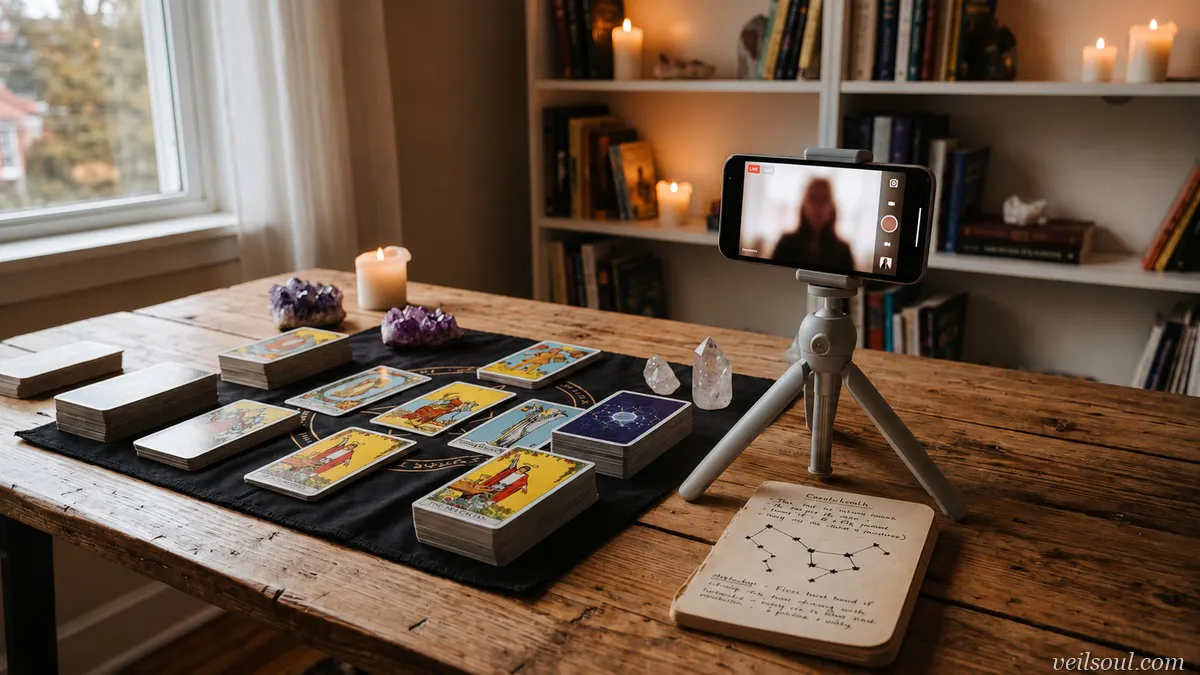
Your best friend lives three time zones away. She called at midnight her time, voice thick with the kind of exhaustion that comes from making the same decision every morning to stay in a job that's slowly eroding her. She asked you to pull cards for her. You said yes. And now you're sitting with your deck, wondering: can this actually work if she's not here?
Yes. Unambiguously yes. Distance readings are one of tarot's most common practices — professional readers do them constantly via video call, phone, text, and even email. The idea that tarot requires physical proximity is a myth rooted in the misconception that the cards are reading the person's physical energy field. They're not. They're responding to the reader's focused attention on the querent's situation. And attention has no zip code.
Why Distance Readings Work
Tarot doesn't read bodies. It reads questions, intentions, and the patterns of a situation. None of these require the person to be physically present.
When you shuffle cards while focusing on your friend's career question, you're directing your attention — and by extension, your intuitive pattern-recognition — toward her situation. The cards that fall respond to that focused attention. Whether she's sitting across the table or across the ocean is irrelevant to the mechanism. The cards are mirrors for the mind of the reader focused on the question. Your mind. Your focus. Her question.
Rachel Pollack read for people via letter for decades — long before video calls existed. She found that the distance between reader and querent had no measurable effect on the reading's accuracy or depth. What mattered was the clarity of the question and the focus of the reader. Mary K. Greer corroborated this, noting that some of her most accurate readings were done for people she'd never met in person.
If you want a framework beyond intuition: Carl Jung's concept of synchronicity — meaningful coincidence that isn't caused by direct physical connection — provides one explanation. The cards don't need to be in the same room as the querent because the connection isn't physical. It's informational. Symbolic. The same reason you can read a letter and feel the writer's emotion even though they wrote it months ago and miles away.
Step-by-Step: How to Do a Distance Reading
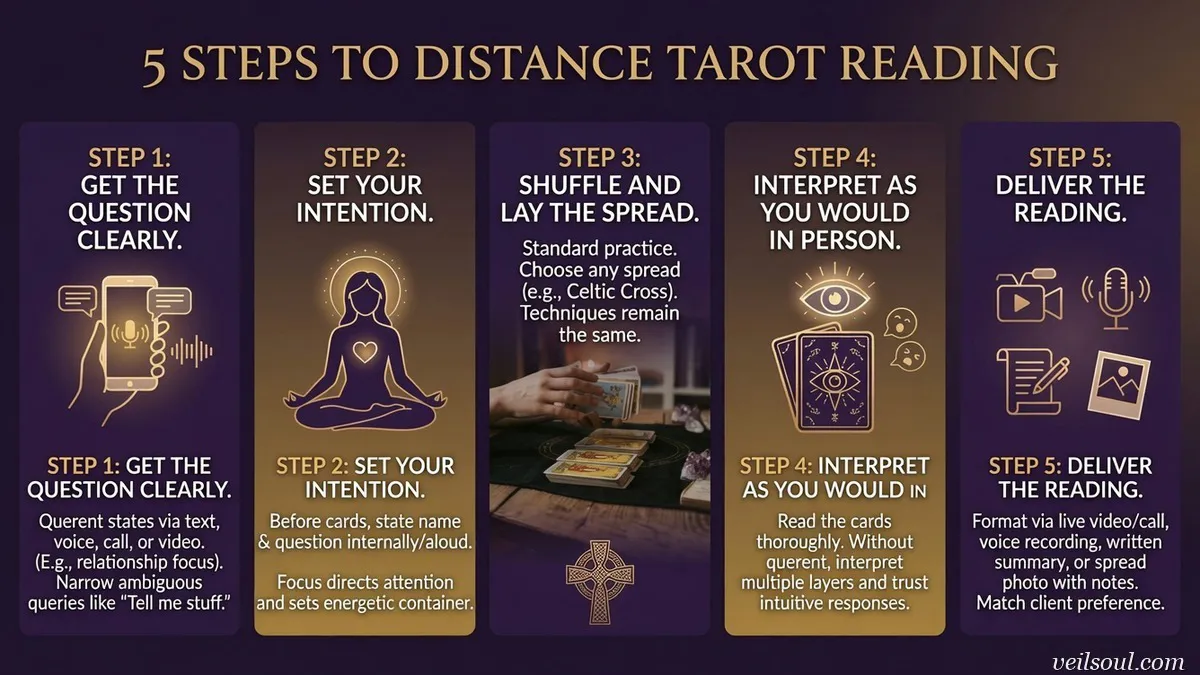
Distance readings follow the same process as in-person readings, with a few modifications for the lack of physical presence.
Step 1: Get the question clearly. Have the querent state their question — via text, voice message, call, or video. Exact wording matters. "What should I know about my relationship with Alex?" is usable. "Tell me stuff" is not. If the person can't articulate a question, help them narrow it: what's the one thing keeping them up at night? Start there. See our guide on asking effective tarot questions.
Step 2: Set your intention. Before touching the cards, take a moment to focus. State — aloud or internally — the person's name and their question. "I am reading for [Name] regarding [their question]." This directs your attention and sets the energetic container for the reading. Some readers visualize the person; others simply hold their name in mind. Both approaches work.
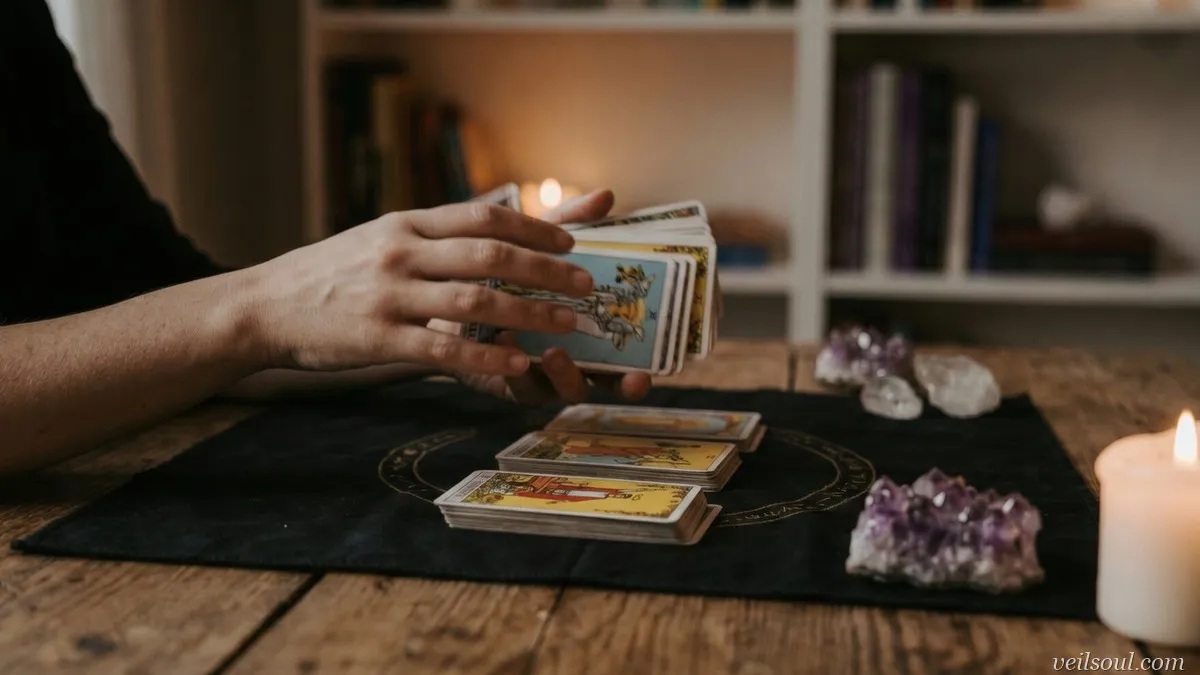
Step 3: Shuffle and lay the spread. Same as any reading. Use whatever spread suits the question — Celtic Cross for depth, three-card for clarity, Two Paths for decisions. Your shuffle technique and spread choice don't change for distance readings.
Step 4: Interpret as you would in person. Read the cards. Trust your intuitive responses. The main difference: without the querent present, you miss their real-time reactions — the gasp, the nod, the tears that confirm you're on the right track. To compensate, interpret more thoroughly and present multiple possible layers rather than drilling into one interpretation based on visible reactions.
Step 5: Deliver the reading. This is where distance readings differ most from in-person ones. Options include live video/phone call (closest to in-person experience), voice message recording (allows the querent to replay), written summary (most thorough but loses vocal tone), or photo of the spread with notes (visual plus written). Choose the format that matches the querent's preference and the depth of the reading.
"My sister lives in London. I'm in the countryside. When our mother was diagnosed, she called me crying and asked me to pull cards. I did a Celtic Cross with her on speaker. Central card: Strength. The woman gently holding the lion's jaw — patience, courage, quiet endurance. 'That's Mum,' my sister said instantly, three thousand miles away. And she was right. Position 7 — the inner world — was The Star. Hope beneath the fear. Healing as the underlying current beneath the crisis. My sister cried harder, but differently — not from despair, from relief. 'I needed to see that Star,' she said. 'I needed to know there's hope under all of this.' The reading was as powerful as any I've done in person. Maybe more — because the distance made us both more intentional, more focused, more present. We weren't distracted by each other's body language. We were listening to the cards and only the cards."
Distance Reading Formats That Work
Different delivery methods suit different situations. Here's what works best for each.
Live video call: The gold standard for distance readings. You see each other's reactions, can adjust interpretation in real-time, and the experience feels closest to sitting across a table. Both reader and querent should be in a quiet, private space. Share the card images via camera or screen share.
Phone/voice call: Excellent for clients who prefer audio. Without visual distraction, both parties often listen more deeply. The reader describes each card verbally, which forces more thorough interpretation than pointing at an image and saying "see?"
Voice note exchange: The reader records a 15-30 minute interpretation and sends it. The querent can listen multiple times, catching layers they missed on first hearing. This format works well across time zones — no scheduling needed.
Written reading with photos: Photograph the spread, then write detailed interpretations. This is the most labor-intensive format but produces a tangible document the querent can revisit for months. Professional email readers use this format extensively.
Text/chat reading: Real-time text exchange where the reader pulls cards and discusses them card by card with the querent. Slower than voice but allows the querent to ask clarifying questions as you go. Popular with younger clients who are more comfortable texting than talking.
Tips for Maximizing Accuracy at a Distance
Distance readings lose certain in-person cues. Here's how to compensate.
- Ask for context upfront. In person, you read body language and adjust. At a distance, ask the querent to share relevant background — not to fish for answers, but to calibrate your interpretation. "Tell me enough about the situation that I can read these cards in the right context."
- Offer multiple interpretations. Without seeing the querent's face, you can't tell which layer of a card's meaning resonates. Present two or three possibilities and let them identify which fits: "The Empress here could mean creativity is your path forward, OR that you need to nurture yourself more, OR that a maternal figure is relevant. Which lands?"
- Trust your strongest hit. Even at a distance, your intuition will often produce one interpretation that feels more certain than others. Trust that one. It's your unconscious mind processing the question and cards with more data than your conscious mind can track.
- Follow up. After the reading, check in with the querent a few weeks later. Distance readings benefit from this follow-up loop more than in-person ones, because it closes the feedback cycle that physical cues normally provide. Their feedback improves your future distance readings.
"I read for a stranger via email — someone who found my website and sent a question about whether to move countries for a job. No video. No call. Just a question in my inbox. I pulled a Two Paths spread. Path A (stay): stable but stagnant — Four of Cups energy, arms crossed, opportunities ignored. Path B (move): terrifying but alive — The Fool energy, cliff's edge, that exhilarating moment before the leap. I wrote a detailed reading and sent it. Three days later, a reply: 'I showed this to my partner, who has never had a tarot reading. She read every word and said: this person knows us. How?' I didn't know them. I knew the cards. And the cards knew the situation — because the situation was in the question, and the question was clear enough to read from anywhere in the world."
Frequently Asked Questions
Can I read for someone without their knowledge or permission?
Ethically, you shouldn't. Reading for someone without their consent raises the same ethical issues as reading someone's diary — even if your intentions are good. If you're concerned about someone, the tarot-appropriate response is to read about your own relationship to the situation: "What do I need to know about my role in [person's] situation?" This keeps you in your own lane while still gaining insight.
Is a distance reading less accurate than in-person?
Not inherently. Studies by tarot researchers (informal, not clinical) consistently find no significant accuracy difference between distance and in-person readings. What changes is the experience — in-person readings feel more intimate, and the reader can adjust in real-time based on the querent's reactions. But the cards themselves don't care about geography.
Can I read for someone I've never met?
Yes — professional readers do this constantly. You don't need a personal relationship with the querent for an accurate reading. You need their question, their first name (some readers prefer this for intention-setting), and your focused attention. The personal connection helps with nuance but isn't required for accuracy.
What if the reading feels "off" when reading at a distance?
It might mean your focus wasn't fully on the querent — distractions, fatigue, or your own emotional state can interfere. Re-center, re-state the intention, and try again. If it still feels off, honestly tell the querent: "I'm not getting a clear connection today." Better to reschedule than to force a muddy reading. See why readings sometimes don't make sense for more troubleshooting.
Distance readings work because tarot has never been about physical proximity. It's about attention, intention, and the willingness to hold someone's question with enough care that the cards respond to the caring, not the mileage. You can read for your neighbor next door or your cousin in another hemisphere. The cards don't measure distance. They measure focus. Give them yours — fully, honestly, with the person's question held clearly in your mind — and the distance disappears.
The distance reading that convinced me forever: a woman in Japan sent me a single question via email at 3 AM her time. I pulled cards at 2 PM my time — twelve hours and eight thousand miles apart. The reading described her situation so precisely that she replied with one word: "How?" I still don't have a satisfying answer to that question. I just know that it works. And it has worked, reliably, for everyone I've read for across every distance and every medium. The cards don't need you in the room. They just need you in the question.
Need a reading from wherever you are? Try a free distance reading with Veil Soul — works from anywhere in the world.
chat_bubble 0 Comments
Leave a Comment