
How to Read Timing in Tarot Cards: When Will It Happen?
Veil Soul
Published on · 10 min read
Key Takeaways
- Tarot is notoriously imprecise about timing because it reads energy, not calendars — and energy doesn't operate on human schedules
- The most reliable timing indicators are suit associations (Wands=days/spring, Cups=weeks/summer, Swords=weeks/autumn, Pentacles=months/winter) combined with card numbers
- The honest truth: tarot works better as a "what" and "how" tool than a "when" tool. The most useful timing question isn't "when will this happen" but "what needs to happen first"
"When?" It's the question every tarot reader dreads — not because the cards can't give timing information, but because they give it in the most frustratingly vague way possible. You want a date. The cards give you a season. You want a week. The cards give you a feeling. You want certainty. The cards give you "when you're ready" — which is the most infuriating answer in the universe when you're already convinced you're ready now.
I'll be honest with you: timing is tarot's weakest skill. The cards excel at showing you what's happening, why it's happening, and what you need to do about it. They're mediocre at telling you when. But "mediocre" isn't "useless" — there are genuine timing techniques that experienced readers use, and understanding their limitations makes them more useful, not less.
The Suit-Based Timing System
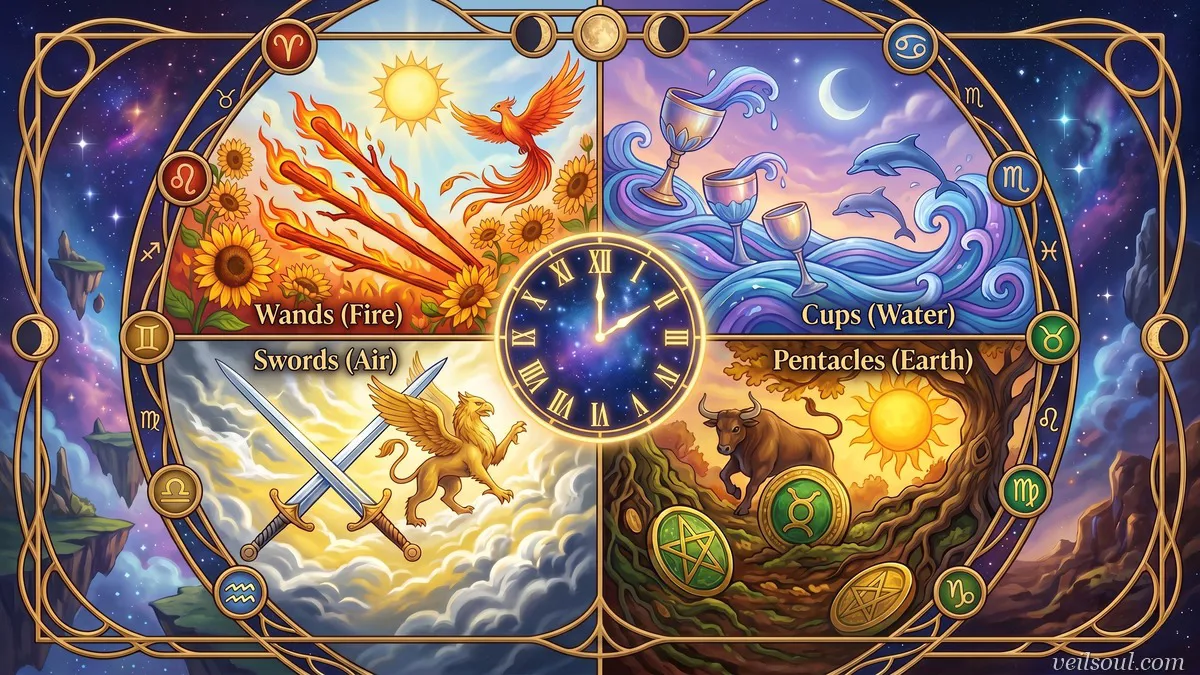
The most widely used timing framework associates each suit with a speed and a season. It's not precise — but it provides a useful general range.
Wands (Fire): Fast. Days to weeks. Spring energy. Things ignited by Wands move quickly — they have the urgency of fire. When the Ace of Wands appears in a timing question, expect movement soon — that budding branch offered from the cloud is alive and growing now, not in six months.
Cups (Water): Moderate. Weeks to months. Summer energy. Emotional developments have their own pace — they can't be rushed without being damaged. Ace of Cups timing suggests the emotional opening is approaching but needs time to fill. Water flows at its own speed.
Swords (Air): Variable. Days to weeks, but unpredictable. Autumn energy. Mental shifts can happen in an instant — the Ace of Swords breakthrough of clarity can arrive like a lightning bolt. But the decision that follows the clarity might take much longer. Swords timing is the most unreliable because the mind operates in bursts, not steady streams.
Pentacles (Earth): Slow. Months to a year. Winter energy. Material manifestation takes time — careers build slowly, financial changes unfold gradually, physical health shifts are measured in seasons, not days. The Ace of Pentacles — that golden coin held by a divine hand above a garden — is a seed. Seeds don't sprout overnight.
Numbers as Timeline Markers

Combine the suit's speed with the card's number for more specific (though still approximate) timing.
Three of Wands = roughly three days to three weeks. Seven of Cups = roughly seven weeks. Four of Pentacles = roughly four months. The number provides the quantity; the suit provides the unit. This system was popularized by multiple tarot traditions and remains the most practical quick-reference for timing questions.
Aces suggest the very beginning — days away or already starting. Tens suggest the very end — the cycle is nearly complete. Court cards are trickier: they often represent people or personality aspects rather than timeframes, making them less useful as timing indicators.
Major Arcana Timing

Major Arcana cards in timing positions indicate that the timing isn't in your hands — larger forces are at work, and they operate on their own schedule.
Wheel of Fortune in a timing question is the universe saying: soon, and from a direction you're not watching. The Wheel turns on its own axis. The Hanged Man says: not yet. Suspension is required. The timing is in the waiting itself — the thing will happen when you've learned what the pause is teaching you. The World says: the cycle is completing. The timing is now or very soon — everything is aligning for closure.
Rachel Pollack noted that Major Arcana timing often corresponds to internal readiness rather than external events. Death doesn't happen on a calendar date — it happens when the old thing has fully expired. The Star arrives when you're finally vulnerable enough to receive healing. The "when" is tied to your growth, not your watch.
"He wanted to know when he'd meet someone. Classic timing question. I pulled three cards: The Hermit, Two of Cups, Wheel of Fortune. 'The Hermit comes first,' I said. 'That's your current season — solitude, self-knowledge, the lantern on the mountain. The Two of Cups is what follows — genuine, mutual connection. But the Wheel between them is the timing.' 'So when?' he pressed. 'When the Hermit's work is done,' I said. 'When you've spent enough time with your own lantern that you can recognize someone else's light without mistaking your loneliness for love.' He looked annoyed. Then resigned. Then thoughtful. 'I'm not ready,' he admitted. 'I want to be. But I'm not.' Six months later, after therapy and genuine solitary healing, he met someone at a bookshop. He texted me: 'The Hermit finished. The Cups showed up. You were right — the when was never a date. It was a readiness.'"
Better Timing Questions to Ask
Instead of asking "when," try these reframes that give the cards more to work with.
- "What needs to happen before X can manifest?" — This replaces a calendar question with a process question, which tarot answers brilliantly.
- "What is the energy of the next month/season regarding X?" — Gives the cards a defined timeframe to read within.
- "Is the timing right for me to act on X now?" — A yes/no timing question that the cards can handle with more clarity than open-ended "when."
- "What is blocking X from manifesting sooner?" — Turns timing into actionable insight. If you remove the block, you change the timeline.
Mary K. Greer recommended what she called the "prerequisite spread" — instead of asking when, pull three cards for "what must happen first, what must happen second, what must happen third." This gives you a sequence without demanding a date, and it puts you back in the driver's seat: complete the prerequisites and the timing takes care of itself.
Seasonal and Astrological Timing
Beyond suits and numbers, some readers use astrological correspondences built into the tarot system for more specific timing windows.
Each Major Arcana card corresponds to a zodiac sign or planet. The Emperor corresponds to Aries (March 21-April 19). The Lovers corresponds to Gemini (May 21-June 20). Strength corresponds to Leo (July 23-August 22). When these cards appear in timing positions, the corresponding zodiac season may be the relevant timeframe.
Court cards also carry astrological timing: Kings often correspond to fixed signs (Taurus, Leo, Scorpio, Aquarius), Queens to cardinal signs (Aries, Cancer, Libra, Capricorn), Knights to mutable signs (Gemini, Virgo, Sagittarius, Pisces). This system provides twelve possible timing windows across the year — far more specific than suit-based timing, though still not calendar-date precise.
The seasonal approach works particularly well for questions about natural cycles — career advancement often aligns with fiscal quarters, relationship milestones cluster around holidays and summers, academic decisions follow school calendars. When a Empress (Venus/Taurus energy) appears in a timing question about a creative project, spring might be when the creative energy peaks and the work finds its audience. Understanding these natural rhythms and aligning your expectations with them transforms timing from a source of frustration into a tool for strategic patience — knowing not just that something is coming, but which season it belongs to.
The Honest Limitations of Tarot Timing
Any reader who claims they can tell you the exact date something will happen is either extraordinary or lying — and it's almost always the latter.
Tarot reads energy, not calendars. Energy doesn't know what day it is. It knows about momentum, readiness, alignment, and resistance — all of which affect timing but none of which produce dates. A reading can tell you that the energy for a new job is building (accurate), but it can't tell you that you'll receive the offer on March 15th at 2 PM (fantasy).
The most ethical approach to timing in tarot is transparency: "The cards suggest this is developing over the next few months" is honest. "You'll meet your soulmate on June 7th" is irresponsible. For more on what tarot can and can't do, see our guide on whether tarot predicts the future.
Frequently Asked Questions
Can I do a timing-specific spread?
Yes — pull 12 cards in a clock formation (like a birthday spread), with each card representing a month. Look for the month position where the energy related to your question is strongest. This gives you a range rather than a date, which is the most honest timing a spread can provide.
Why do different readers give different timeframes for the same cards?
Because timing systems vary across traditions. Some readers use astrological associations, others use suit-speed systems, others rely purely on intuition. There's no universally agreed-upon tarot timing method — which is itself evidence that timing is tarot's interpretive soft spot.
What if the cards say "not yet" and I'm impatient?
"Not yet" is one of the most valuable timing answers tarot gives. It means the conditions aren't right — not that the thing won't happen. Impatience is natural, but acting before the energy is ready often creates the very problems you're trying to avoid. Trust the pause. The Seven of Pentacles farmer leaning on his hoe, watching the unripe vine — he's not idle. He's waiting with intention. That's different from passivity.
Is timing more accurate with astrology combined?
Many readers find that combining tarot with astrological transits provides more precise timing. Each card has astrological correspondences (e.g., Death = Scorpio, Temperance = Sagittarius) that can anchor timing to specific zodiac seasons. This hybrid approach is more precise but requires knowledge of both systems.
When will it happen? The cards won't give you a date. But they'll give you something more useful: a map of what needs to fall into place first, a reading of the energy's current momentum, and an honest assessment of whether the timing is yours to control or something larger to surrender to. That's not the answer you wanted. It's the answer that actually helps.
The timing reading I remember most was for a woman asking when she'd fall in love again. The cards showed The Hermit transforming into The Empress. "When will it happen?" she asked. "When you stop looking for someone to love you," I said, "and start being someone who loves herself. That's when The Hermit becomes The Empress. That's the timing." She didn't like the answer. But it was true.
Want timing insight for your situation? Try a free reading with Veil Soul, or learn to read your own timing with our self-reading guide.
chat_bubble 0 Comments
Leave a Comment