Why Does My Tarot Reading Not Make Sense? 7 Reasons and Fixes
Veil Soul
Published on · 10 min read
Key Takeaways
- A confusing reading is rarely meaningless — it usually means the question was unclear, the interpretation is too literal, or the answer is showing you something you're not ready to see
- The most common reason for a nonsensical reading is asking one question while emotionally invested in a different one — the cards answer the energy, not always the words
- Photographing confusing readings and revisiting them in 2-4 weeks frequently reveals startling accuracy that was invisible in the moment
Five cards on the table and they might as well be grocery receipts. The Empress in your career position. Seven of Swords as your emotional state. Wheel of Fortune as guidance. Nothing connects to your question about whether to move apartments. You feel stupid, frustrated, and quietly convinced that tarot doesn't actually work — or worse, that you're the one person it doesn't work for.
Take a breath. A confusing reading is not a failed reading. In fifteen years of practice, the readings that initially made the least sense have consistently turned out to be the most profound — because confusion often means the cards are showing you something your conscious mind isn't prepared to process. The problem isn't the cards. It's the gap between what you asked and what you need to hear.
7 Reasons Your Reading Doesn't Make Sense

1. Your question was too vague
"What should I know?" gives the cards infinite territory to wander. The result is often a spread that touches on five different areas of your life without going deep on any of them. Fix: ask a specific question about a specific situation. "What energy surrounds my decision to move to Osaka by September?" gives the cards a clear target. See our guide on asking effective tarot questions.
2. You asked one question but your energy was on another
You said "tell me about my career" but your heart was screaming about the text you haven't received from your partner. The cards read energy first, words second. When those two signals conflict, the reading addresses the louder one — which is almost always the emotional concern, not the stated question. If your reading seems off-topic, ask yourself: what was I actually thinking about while I shuffled?
3. You're interpreting too literally
The Empress in a career position seems wrong because you're thinking "motherhood" and you asked about work. But The Empress is also abundance, creativity, nurturing growth — all directly relevant to career questions. The confusion lifts when you stop matching cards to their most obvious meaning and start reading the energy underneath. Rachel Pollack often reminded students that tarot is a symbolic language, not a dictionary. Symbols are meant to be felt, not decoded.
4. The reading is about a different timeline than you assumed
You asked about next month and the cards answered about next year. You asked about the present and the cards showed you a pattern from your past that's invisibly shaping everything. Tarot doesn't always respect the timeframe you impose on it. When a reading feels off, try reading the cards as though they're addressing a longer or shorter period than you intended. Often, the puzzle clicks when you adjust the temporal lens.
"He photographed a reading he couldn't understand — five cards that seemed to describe someone else's life entirely. Career growth when he was being laid off. Partnership when he was single. Travel when he was broke. He almost deleted the photo. Three months later, scrolling through his camera roll, he found it and stopped breathing. The layoff had led to a freelance contract (career growth). The freelancer he partnered with became his business partner (partnership). Their first client was in another country (travel). Every card had been accurate — about a future he couldn't have imagined from where he stood when he pulled them. 'The reading wasn't confusing,' he told me. 'I just didn't have the context yet. The cards were three months ahead of my understanding.'"
5. The cards are answering a question you didn't ask
This is different from #2. Sometimes you ask a clear question with genuine focus, and the cards answer something else entirely — because the something else is more important. You asked about your finances and the cards are screaming about your health. You asked about your relationship and the cards are focused on your self-worth. The cards aren't ignoring your question. They're prioritizing. And their priorities are usually smarter than ours.
6. You're too emotionally close to the situation
When you're deep inside a situation — especially one involving fear, grief, or intense desire — your interpretive lens is warped. Everything looks like confirmation or denial of your hope/fear. Cards that are genuinely nuanced appear confusing because you can't hold nuance in a state of emotional extremity. Solution: wait 48 hours and re-examine the spread. Or have someone else look at it. Distance creates clarity that no interpretive skill can replicate.
7. The reading is actually clear — you just don't like the answer
The hardest reason to accept. Sometimes a reading "doesn't make sense" because the sense it makes is uncomfortable. The Tower as your outcome is perfectly clear — you just don't want it to be. Death as guidance is perfectly clear — you just wish it weren't. Before concluding a reading is confusing, ask yourself with radical honesty: is it really confusing, or is it inconvenient?
How to Salvage a Confusing Reading
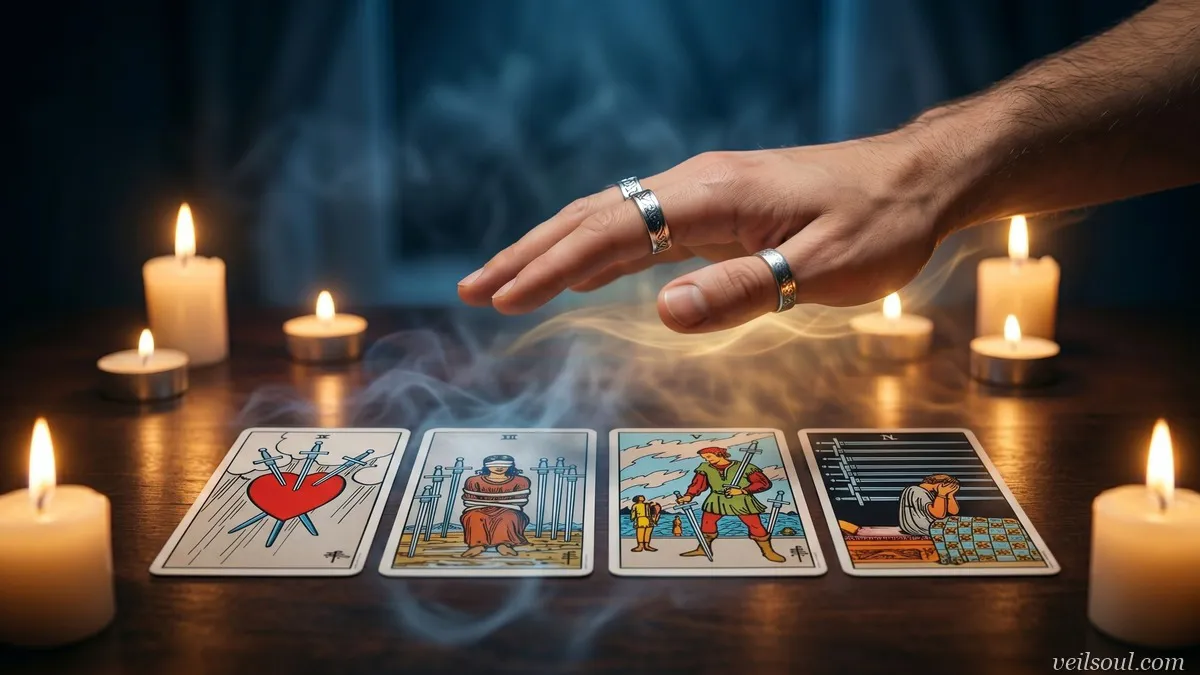
Don't discard confusing readings. Work with them.
- Photograph it. Always. Confusing readings that become clear in hindsight are useless if you can't revisit them. Build a photo library of every spread, especially the ones that puzzle you.
- Pull one clarifier card. Place it beside the most confusing card in the spread and ask: "What is this card trying to tell me that I'm not seeing?" One clarifier — not five. Adding too many cards creates more noise, not more signal.
- Read the spread as a story. Forget individual card meanings. Look at the five or ten cards as characters in a narrative. What story do they tell if you let go of positional meanings and just follow the visual flow from left to right? Mary K. Greer's narrative reading approach often unlocks spreads that positional reading can't crack.
- Come back in 48 hours. Set the photo as your phone wallpaper. Let it sit in your peripheral awareness. Your unconscious mind will continue processing the spread while your conscious mind moves on. Insights often arrive in the shower, during a walk, or just before sleep — when the analytical mind relaxes its grip.
- Ask someone else. A fresh pair of eyes, unattached to your question and emotions, often sees what you can't. Share the photo with a tarot friend or community — not for a definitive answer, but for perspectives your proximity to the situation has made invisible.
"A woman kept getting readings she described as 'gibberish.' Every spread seemed random. I asked to see her last three readings — she'd photographed them all. Looking at the three spreads side by side, the pattern was immediately obvious to me: every reading prominently featured Swords. Three of Swords. Eight of Swords. Ten of Swords. Queen of Swords. 'These readings aren't gibberish,' I told her. 'They're all saying the same thing. Your mental space is in crisis — overthinking, mental pain, feeling trapped in your own head.' She stared at the photos. 'I've been having panic attacks,' she said quietly. 'For months. I thought the cards were broken. They were the only thing working perfectly.' She started therapy the following week. The cards had been speaking clearly the entire time. She just needed someone outside her own head to translate."
Learning to Sit With Not-Knowing

The deepest skill in tarot is not interpretation — it is the ability to hold a confusing reading without forcing it into premature clarity.
Our culture rewards instant understanding. We Google answers in seconds. We want the reading to click immediately, the way a horoscope does — neat, digestible, applicable by morning. But tarot operates on a different timeline. Some readings are seeds that germinate over weeks. Some are letters written in an alphabet you will only learn by living through the experiences the cards describe.
The practice of sitting with confusion — of trusting that meaning will arrive on its own schedule — is one of the most valuable skills tarot teaches. It transfers to every other area of life where certainty is unavailable: relationships, career changes, grief, creative work. The person who can hold "I do not understand yet" without panicking is the person who eventually understands most deeply.
Frequently Asked Questions
Should I redo a confusing reading immediately?
No. Pulling again immediately usually produces a different but equally confusing spread — because you haven't changed, the situation hasn't changed, and now you have twice the data and twice the confusion. Wait at least 48 hours. If the original reading still makes no sense after reflection, then consider a fresh pull with a reworded question.
Does a confusing reading mean I'm bad at tarot?
No. Even experienced readers encounter confusing spreads regularly. Confusion isn't a skill deficit — it's a signal. The most skilled reader in the world will be confused by a reading that addresses something they're not ready to see. Skill makes more readings clear, not all readings clear. See our guide on learning tarot for realistic expectations.
Can I trust a reading I don't understand?
Trust it enough to keep it. Not enough to act on it blindly. A confusing reading deserves the respect of being preserved (photograph it), revisited (check it in 2-4 weeks), and held lightly (neither dismissed nor followed without understanding). Trust is earned through the retrospective accuracy that confusing readings often reveal over time.
What if every reading I do is confusing?
Chronic confusion across multiple readings usually indicates one of two things: you need stronger foundational knowledge of card meanings (study and practice will help), or you're in a life period so turbulent that clarity is genuinely unavailable right now. For the first: revisit basics with our beginner's guide. For the second: take a break from reading and return when the dust settles.
A confusing reading is an invitation — not to force understanding, but to expand it. The cards are showing you something your current frame of reference can't contain. Instead of squeezing the reading into a frame that fits, consider that maybe the frame needs to grow. Every reading you don't immediately understand is a reading that's asking you to become a slightly bigger version of yourself — someone capable of holding the truth the cards are offering.
The reading I'm most grateful for is one I couldn't understand for six months. When it finally clicked — sitting in a completely different country, living a completely different life — I realized the cards hadn't been confusing. They'd been prophetic. And I'd needed every one of those six months to become the person who could read them.
Need clarity? Try a free reading with Veil Soul, or strengthen your interpretive skills with our intuition-building guide.
chat_bubble 0 Comments
Leave a Comment