How to Connect Multiple Tarot Cards Into a Coherent Story
Veil Soul
Published on · 10 min read
Key Takeaways
- Individual card meanings are vocabulary — connecting cards into a story is grammar. A reading only becomes useful when the cards form sentences, not just a list of disconnected words
- The key technique is reading relationships between adjacent cards: what does Card A say to Card B? How does Card B change or deepen Card A's meaning?
- Start with the two cards that create the strongest contrast or tension — that's the reading's spine. Everything else is commentary on that central dynamic
You can read every card in the deck. You know that The Tower means disruption and The Star means hope and Eight of Cups means walking away. But when all three appear in the same spread, you stare at them and think: okay, but what does this mean — together? How do disruption, hope, and departure form one story?
This is where most tarot learning stalls. You've memorized meanings but can't synthesize them. It's like knowing every word in French but being unable to form a sentence. The skill of connecting cards is the skill that transforms reading from a mechanical exercise into genuine insight — and it's surprisingly teachable once you understand the mechanics.
The Adjacency Principle: Cards Talk to Their Neighbors
The most important relationship in any spread is between adjacent cards. Each card modifies the meaning of the cards beside it — like adjectives modify nouns.
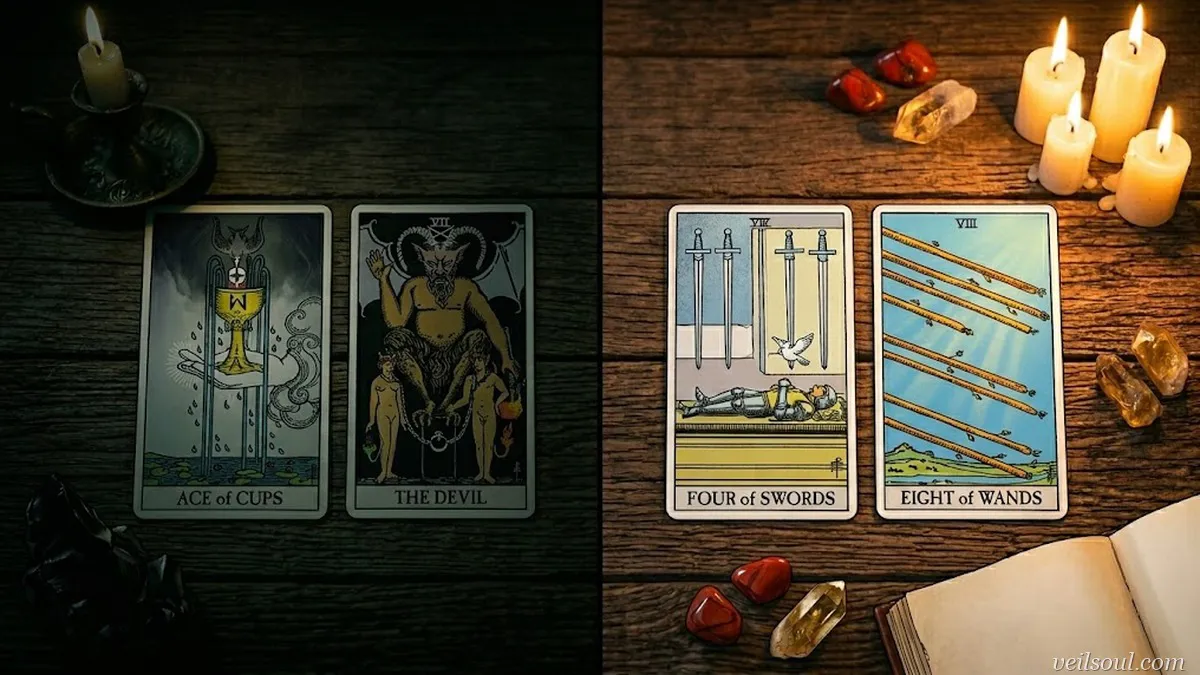
Ace of Cups alone means new emotional beginnings. Ace of Cups next to The Devil means new emotional beginnings tangled with addiction, obsession, or unhealthy attachment. The Ace hasn't changed. The Devil hasn't changed. But together they create a meaning neither card holds alone: the intoxicating rush of new connection that could become a prison.
Four of Swords alone means rest and recovery. Four of Swords next to Eight of Wands — that burst of eight flying staffs, rapid movement, things accelerating — creates a contradiction that IS the message: you need rest, but life is speeding up. The tension between the two cards is more informative than either card in isolation.
Mary K. Greer called this "dialogic reading" — treating cards as speakers in a conversation rather than isolated statements. Every card responds to its neighbors, and the response creates meaning that transcends individual definitions.
Five Techniques for Connecting Cards
1. The Sentence Method
Build a literal sentence: "[Card 1] BECAUSE OF [Card 2], LEADING TO [Card 3]." Example: "She's walking away from everything she built (Eight of Cups) BECAUSE her personal power was compromised (Emperor reversed), LEADING TO a period of healing in solitude (The Hermit)." The connecting words — because, leading to, despite, through — are yours to choose based on the reading's feel.
2. The Visual Gaze Method
In the RWS deck, figures face specific directions. Look at where they gaze. If the figure in Card 1 faces right (toward Card 2), they're moving toward that energy. If they face away, they're leaving it behind. The Eight of Cups figure walks to the right — toward whatever card sits next to it. Place The Star there and the story writes itself: walking away from emotional stagnation toward healing and vulnerability.
3. The Elemental Flow
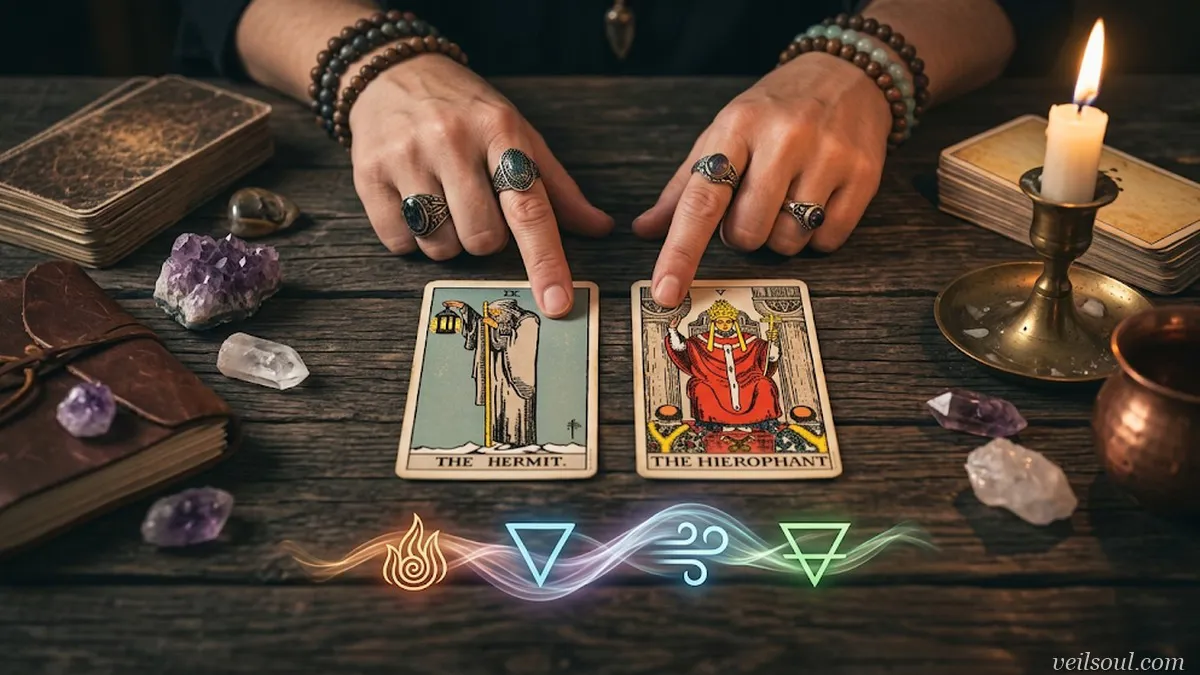
Track the elements across the spread. Water (Cups) flowing into Fire (Wands) creates steam — emotions fueling passionate action. Earth (Pentacles) followed by Air (Swords) suggests practical reality being disrupted by new thinking. Rachel Pollack taught that elemental transitions between cards often mirror the querent's real-life experience of moving between different modes of being.
4. The Contrast Search
Find the two cards that create the strongest contrast — the most unlikely pair. Nine of Cups (the wish fulfilled, satisfaction, that smug figure with arms crossed before nine golden chalices) next to Five of Cups (grief, loss, the figure mourning spilled cups). Wish fulfillment next to grief. The story: getting what you wanted brought its own loss. Or: you're so focused on what's missing that you can't enjoy what you have. The contrast IS the insight.
5. The Narrative Arc
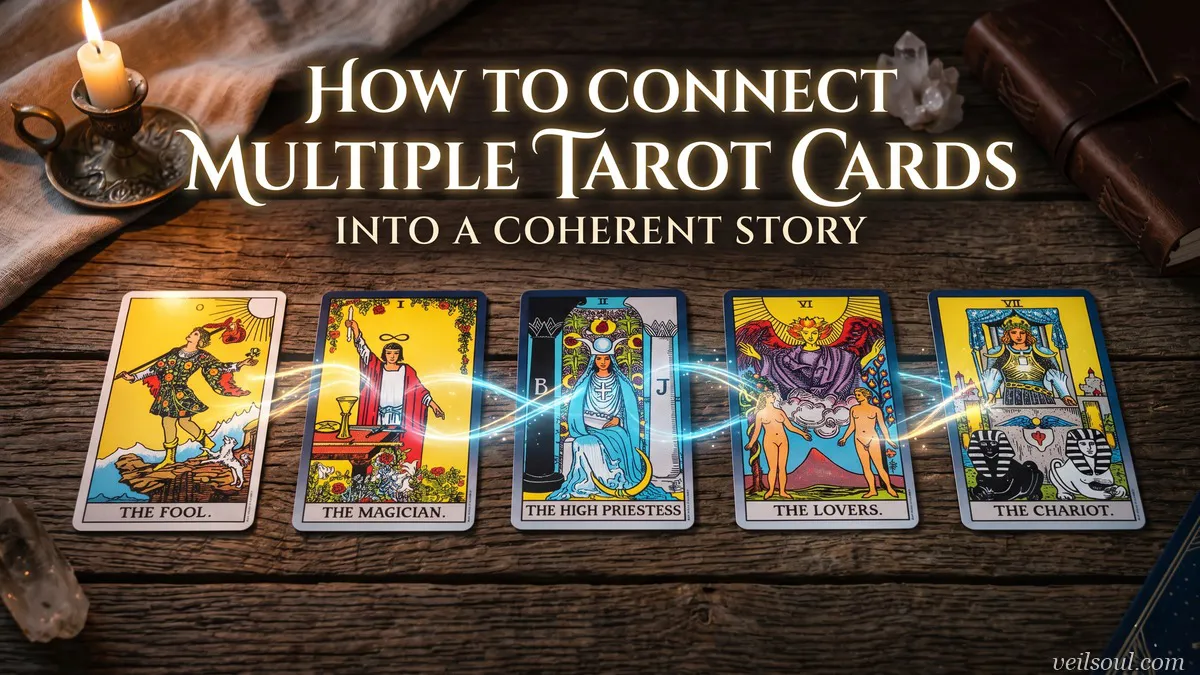
Read the spread as a story with beginning, middle, and end. The first card sets the scene. The middle cards develop complications, challenges, and turning points. The final card resolves — or doesn't. A spread that starts with The Fool (new beginning, innocence) and ends with The World (completion, integration) tells a story of a full cycle — naivete maturing into wisdom. A spread that starts with The World and ends with The Fool tells the opposite: completion dissolving into new, uncertain territory.
"She laid five cards and read them one by one, like a grocery list: 'Empress means abundance. Tower means disruption. Hermit means solitude. Ace of Wands means new beginning. Ten of Cups means happiness.' Technically correct. Completely useless. 'Now forget the meanings,' I said. 'Tell me the story these five images tell.' She looked at them differently — as a sequence, not a catalog. 'Someone who had everything... lost it all suddenly... retreated inward to figure out who they were without it... found a single spark of new passion... and built a completely different kind of happiness from the ground up.' She stopped. 'That's my mother's story,' she whispered. 'She went through exactly that after the divorce.' The cards hadn't changed. The technique had. She stopped reading words and started reading the story between them."
Three Mistakes That Break the Narrative
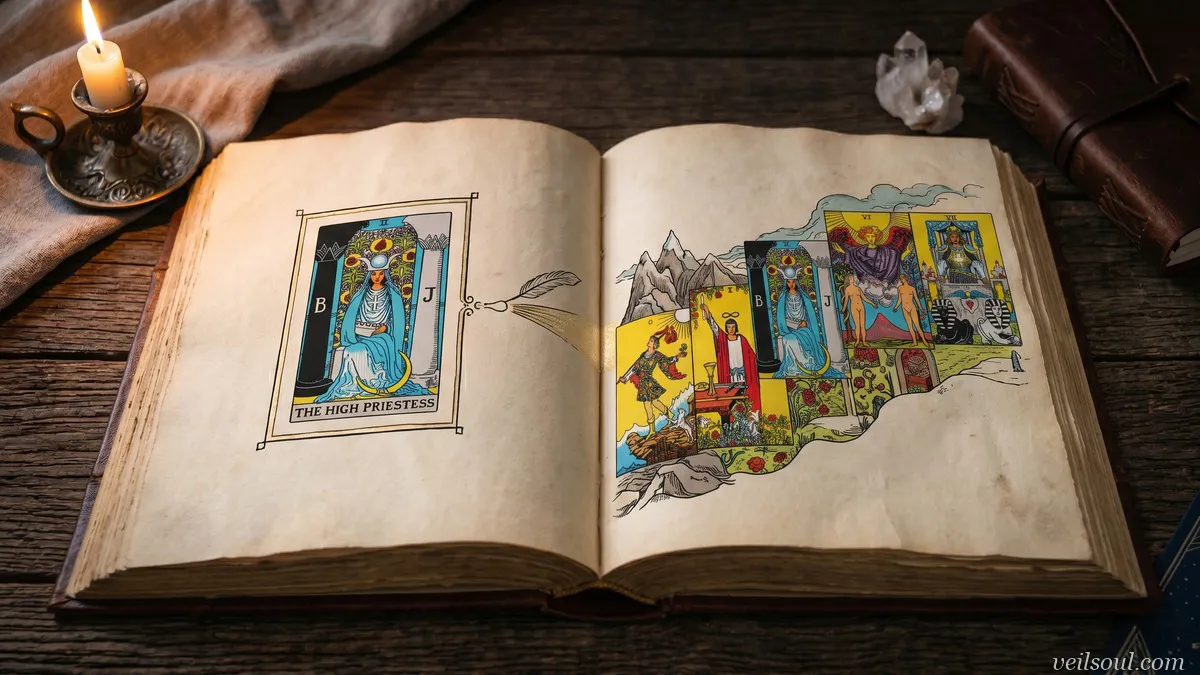
Even knowing the techniques, these errors can prevent cards from connecting.
Reading cards in isolation then trying to synthesize afterward. Don't read Card 1, note its meaning, then Card 2, note its meaning, then try to stitch them together. Read them simultaneously — lay the whole spread, step back, and look at the pattern before interpreting individual cards. The story lives in the gestalt, not the pieces.
Ignoring cards that seem irrelevant. The card that doesn't seem to fit is often the most important one — it's the plot twist, the hidden variable, the thing you haven't considered. If The Empress appears in a career spread and you think "that's irrelevant," reconsider: maybe the career question is actually about nurturing, creating something from soil and patience, or the feminine energy you've been suppressing in a masculine-coded workplace.
Forcing a single story when the cards tell two. Sometimes a spread contains two narratives — one in the cross and one in the staff of a Celtic Cross, or one in the first three cards and another in the last three of a six-card spread. If the cards resist forming one story, let them tell two. The relationship between the two stories is itself a reading.
When Cards Refuse to Connect
Sometimes cards genuinely resist forming a coherent narrative. This happens, and it's informative in itself.
A spread that refuses to cohere often mirrors a situation that refuses to cohere — a life moment so chaotic or transitional that no clean story exists yet. The cards aren't failing to connect. They're accurately reflecting disconnection. When this happens, name it: "These cards are showing me fragmentation. The situation doesn't have a story yet — it has fragments. And that fragmentation is the current truth." Sometimes the most accurate reading is the one that honestly says: there's no narrative here yet. There's a collection of forces that haven't assembled into a shape. And that is the reading — the shape is still forming, and forcing a premature story would be less honest than admitting the pieces haven't fallen into place.
Practice Exercise: The Three-Card Story
The fastest way to develop card-connecting skill is this daily exercise.
Pull three cards. Set a timer for three minutes. Tell the story out loud — beginning, middle, end — without checking any meanings. Use only what you see in the images and what you feel. Record yourself if possible; listening back reveals connections you missed while speaking.
Do this daily for thirty days. By day ten, the stories will flow more easily. By day twenty, you'll start noticing connections automatically. By day thirty, you'll look at any spread and see the narrative before you see the individual cards. That's the shift from reader to storyteller — and it's the skill that makes tarot genuinely useful rather than merely interesting.
Frequently Asked Questions
What if I connect the cards into a story that doesn't match the traditional interpretation?
Your intuitive narrative is usually more accurate for the specific situation than the textbook connection. If the traditional meaning of The Lovers is "choice" but your intuitive reading sees it as "alignment between values and action," trust your reading. The traditional meaning is a starting point, not a cage. For more on trusting your instincts, see our intuitive reading guide.
How many cards should I try to connect at once?
Start with two. Then three. Then five. Don't attempt a full Celtic Cross narrative until you're comfortable with three-card stories. Building narrative muscle is like building physical muscle — progressive overload, not sudden maximal effort.
Does card order matter for the story?
In a positional spread (past-present-future, Celtic Cross), yes — the positions create a built-in narrative structure. In a free-form pull, you choose the order based on intuition. Some readers read left to right. Others start with the card that draws their eye first and build outward. There's no wrong approach — only the one that produces coherent stories.
What if two cards seem to contradict each other?
Contradictions are features, not bugs. Real life is full of contradictions — wanting to leave but being afraid to go, loving someone who hurts you, craving change while clinging to stability. When cards contradict, the contradiction IS the reading. Name it: "You want X and Y, and they're pulling in opposite directions. That tension is the core of your situation."
Cards are words. Connections are sentences. Stories are readings. Every spread you lay is a story waiting to be told — not by the cards alone, but by the mind that sees the threads between them. The cards provide the vocabulary. You provide the grammar. And the grammar — the because, the therefore, the despite, the leading to — is where the meaning lives.
The most connected reading I ever witnessed was by a reader who was legally blind. She couldn't see the card details — just colors and general shapes. But she felt the energy between cards with a precision that sighted readers rarely achieve. "This one is warm and this one is cold," she'd say, hands hovering. "The warmth is reaching toward the cold. Someone is trying to love something frozen." That was The Empress reaching toward Four of Cups. She couldn't see the images. She didn't need to. The story was in the space between them.
Ready to read stories? Try a free reading with Veil Soul, or start with our three-card spread mastery guide for structured practice.
chat_bubble 0 Comments
Leave a Comment