How to Read Tarot Intuitively Without Memorizing All 78 Cards
Veil Soul
Published on · 10 min read
Key Takeaways
- Intuitive tarot reading means responding to the images, colors, and gut feelings a card evokes — not reciting memorized definitions. The card is already communicating; your job is to receive, not decode
- The RWS deck was specifically designed so that every card tells a visual story — you can read the images like a picture book before you ever open a textbook
- Memorization and intuition aren't opposed — they're partners. Learn the traditional meanings as a foundation, then let intuition override them when a card speaks directly to the situation in front of you
You bought the deck two weeks ago. The little white book that came with it has 78 entries, each containing three sentences of meaning you can't remember. You've tried flashcards. You've tried apps. You've stared at the Seven of Cups for ten minutes trying to remember whether it means "choices" or "illusions" or "fantasies" and you're ready to throw the entire deck against the wall.
Here's the secret that every experienced reader knows but most tarot books won't tell you: you don't need to memorize all 78 cards to start reading. The Rider-Waite-Smith deck — the one most beginners use — was designed by Pamela Colman Smith to be visually readable. Every card is a scene. Every scene tells a story. And you already know how to read stories. You've been doing it since you were three years old, pointing at picture books and narrating what you saw.
Step 1: Read the Image, Not the Meaning
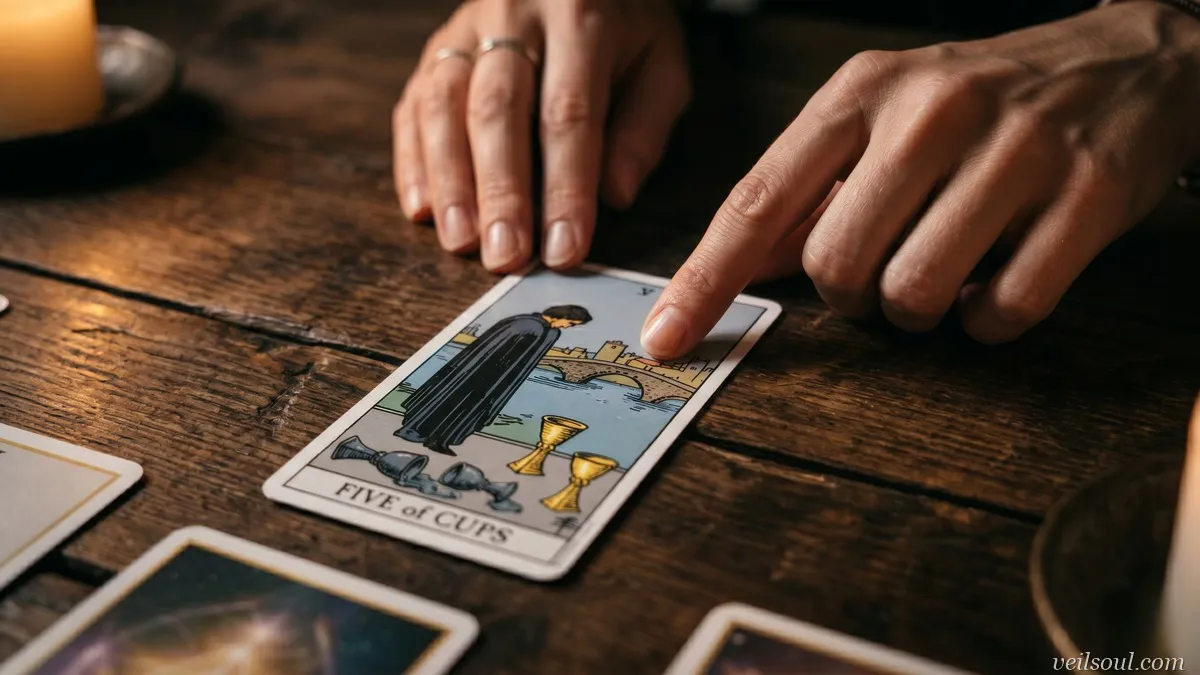
Before you look anything up, look at the card. What do you see? What is the figure doing? How does the image make you feel? That response IS your reading.
Pick up the Five of Cups. Don't check the book. Just look. A figure in a black cloak, hunched over, staring at three overturned cups. Liquid spilled. Behind the figure — two cups still standing. A bridge in the background. A river flowing.
What story does that image tell you? Someone grieving. Focused on loss. Missing what's still there. A way forward exists (the bridge) but they can't see it because they're facing the wrong direction. You just read the Five of Cups. Perfectly. Without memorizing a single keyword.
Now try The Tower. A tall stone tower. Lightning striking its crown. The crown blasting off. Two figures falling. Flames. Gray sky. What does this image say? Sudden destruction. Something built high coming down fast. People displaced. Lightning you didn't see coming. You just read The Tower — and your visceral, unschooled response is probably more vivid than any textbook definition.
Pamela Colman Smith was an artist and storyteller. She embedded the meaning of each card into its imagery so thoroughly that Rachel Pollack called the RWS deck "a book you read with your eyes." Trust your eyes. They're more literate in tarot than you think.
Step 2: Trust the Gut Response Before the Brain
The first thing you feel when you flip a card — before your mind starts analyzing — is almost always the most accurate response. Learn to catch it before the editor arrives.
You flip The Empress. Before you think "fertility, abundance, nurturing" — before any learned definition kicks in — notice what you felt. Warmth? Softness? Maybe something maternal. Maybe something creative. Maybe something about growth and green things and earth. That felt response is your intuition speaking, and it's calibrated to the specific question and the specific person in a way no textbook definition can be.
The brain's response is general: "The Empress means abundance." The gut's response is specific: "This person needs someone to take care of them the way a garden takes care of seeds — with patience and warmth and no expectation of immediate results." The second response is the intuitive reading. It's better. It's more useful. And it came from looking at the card and feeling, not from remembering.
Mary K. Greer developed an exercise she called "first flash" — flip a card and say the very first word that comes to mind, before censoring yourself. Do this daily for a month. You'll build an intuitive vocabulary that's uniquely yours and deeply accurate.
"She was a librarian — a person whose entire life was organized by systems and categories. She approached tarot like she approached the Dewey Decimal system: memorize, classify, shelve. After three months of frustration, she came to me. 'I know what every card means,' she said, 'and I still can't read.' I took her deck, shuffled, and laid one card face-down. 'Don't turn it over yet,' I said. 'Just put your hand on it. What do you feel?' She looked skeptical but played along. 'Heavy,' she said. 'Something heavy and still.' She flipped it: Four of Swords. The knight lying in absolute stillness on his stone tomb. Heavy. Still. 'You just read that card with your hand before your eyes even saw it,' I told her. 'That's intuitive reading. The knowledge is in your body, not your card catalog.' She cried a little. 'I've spent my whole life in my head,' she said. 'The cards are asking me to come down into my body.' That was the reading within the reading — and she didn't need any memorized meaning to receive it."
Step 3: Learn a Minimal Framework (Not 78 Definitions)
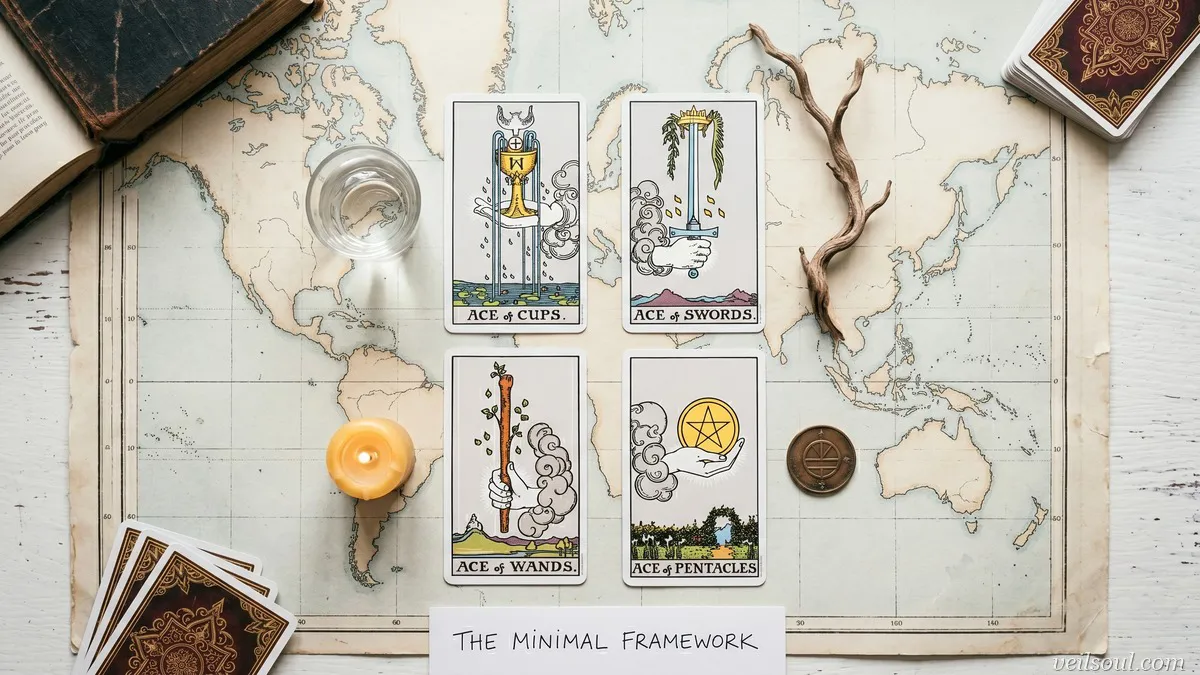
You don't need to memorize every card. You need four suit meanings, a number arc, and the ability to look at pictures. That's your entire foundation.
The four suits:
- Cups = Emotions, relationships, feelings, intuition (Water)
- Swords = Thoughts, communication, conflict, truth (Air)
- Wands = Passion, action, creativity, drive (Fire)
- Pentacles = Material world, money, health, work (Earth)
The number arc:
- Ace = New beginning, pure potential
- 2-3 = Development, early growth
- 4-6 = Stability or conflict, the messy middle
- 7-9 = Challenge, testing, nearing completion
- 10 = Completion, fullness (for better or worse)
Combine these: Seven of Cups = challenge (7) in the emotional realm (Cups). Look at the image: a figure gazing at seven chalices floating in clouds, each containing a different fantasy. Challenge in emotions through too many options, fantasies, or emotional overwhelm. You didn't memorize that. You derived it from a simple framework plus visual observation.
The Major Arcana require individual attention — but even there, the images do most of the work. The Hermit looks like a hermit. The Lovers looks like lovers. The Fool looks like someone about to do something foolish — or brave, depending on your perspective.
Daily Exercises to Build Intuitive Skill
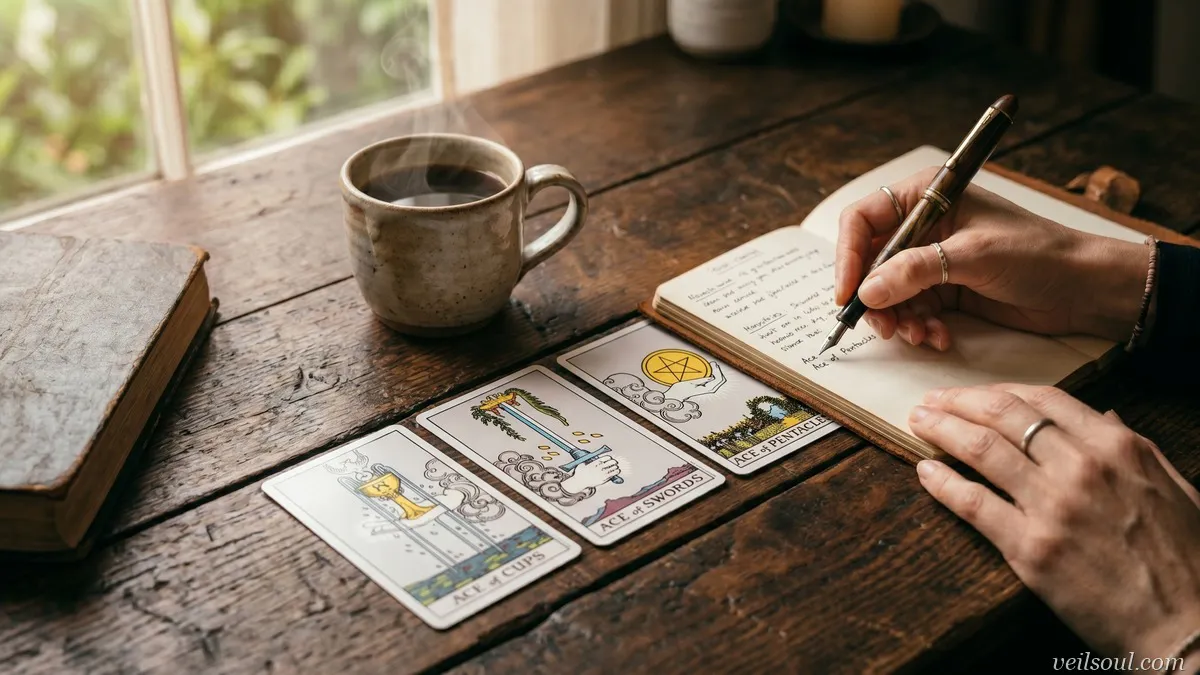
Intuition is a muscle. These exercises build it in under ten minutes a day.
Morning card pull (2 minutes): Pull one card. Don't look it up. Describe what you see in three sentences. Note how it makes you feel. Check the traditional meaning after. Over time, your intuitive descriptions and the traditional meanings will converge — because the images and the meanings were designed together.
Two-card conversation (5 minutes): Pull two cards side by side. Instead of reading them separately, read the relationship between them. What is Card A saying to Card B? If the figures could talk to each other, what would they say? The Hermit next to Three of Cups: the solitary seeker confronted by celebration. Maybe the reading is saying: you've been alone long enough. Join the party.
Storytelling spread (10 minutes): Pull three cards and tell a story — beginning, middle, end — using only what you see in the images. No card names, no traditional meanings. Just: "Once upon a time, a person was doing [Card 1]. Then [Card 2] happened. And in the end, [Card 3]." This exercise builds the narrative muscle that transforms card-by-card reading into fluid, connected interpretation.
"A teenager who'd been reading tarot for exactly three weeks gave the most stunning reading I've ever witnessed. She didn't know the 'proper' meanings. She didn't know spread positions. She just looked at each card and told her friend what she saw. 'This one — the lady pouring water into the ground — she's giving everything away. But look, she's got one foot on land and one in the water. She's connected to both worlds. She's not running out — she's flowing.' That was The Star. And that reading was more precise and more beautiful than most I've heard from twenty-year veterans. She read intuitively because she didn't know there was any other way. The textbook definitions she'd learn later would add precision. But the soul of the reading — that was already there."
Frequently Asked Questions
Will I be less accurate without memorizing meanings?
In the beginning, you might miss some traditional associations. But many experienced readers find that over-reliance on memorized meanings actually decreases accuracy because it creates rigid interpretations that don't flex with context. Intuitive reading is often more accurate for individual situations because it responds to the specific energy present. The ideal is both: traditional knowledge as a foundation, intuitive reading as the living expression.
What if I feel nothing when I look at a card?
You're trying too hard. Stop looking for a mystical hit and just describe what you see. "A person is sitting under a tree. There are cups in front of them. They look bored." That IS a reading. The Four of Cups is boredom, emotional stagnation, refusing what's offered. You read it by describing it. Feeling nothing is also data — maybe the card's message is emotional numbness itself.
Should I use a deck without images (like Marseille) for intuitive reading?
Not for beginners. The RWS deck and its derivatives have images on every card specifically to support intuitive reading. Marseille and pip-based decks show only suit symbols on the Minor Arcana (four cups, seven swords, etc.) — these require more memorized knowledge to read. Start with an illustrated deck. Once your intuition is strong, any deck will speak to you.
Can I mix intuitive and traditional reading?
Not only can you — you should. The best readers do both simultaneously. They see Death and know the traditional meaning (transformation, endings) while simultaneously feeling what this specific Death card means for this specific person in this specific moment. Traditional knowledge is the grammar. Intuition is the poetry. You need both for the language to sing. For more on building this skill, see our intuition-building guide.
You don't need to memorize 78 cards to read tarot. You need to look at pictures and say what you see. That's the beginning and the end of intuitive reading — everything else is refinement. The cards were painted by an artist who put the meaning into the image itself. Your job isn't to translate. It's to receive. Look at the card. Feel what it stirs. Say what you see. That's reading tarot. You've been ready since the first time you looked at a picture and knew what it meant without anyone telling you.
Ready to try intuitive reading? Start with a free reading on Veil Soul, or explore our beginner's guide for the foundation that supports intuitive practice.
chat_bubble 0 Comments
Leave a Comment