What Does It Mean When You Pull the Same Tarot Card Twice?
Veil Soul
Published on · 10 min read
Key Takeaways
- Pulling the same card twice in one session is the tarot equivalent of someone repeating themselves because you weren't listening the first time — the message is urgent and you haven't fully absorbed it
- The card's meaning often deepens on the second pull — the first time shows you the surface, the second time asks you to look at what's underneath
- If you pull the same card twice in separate readings days apart, it indicates an ongoing life theme that won't resolve until you engage with it directly
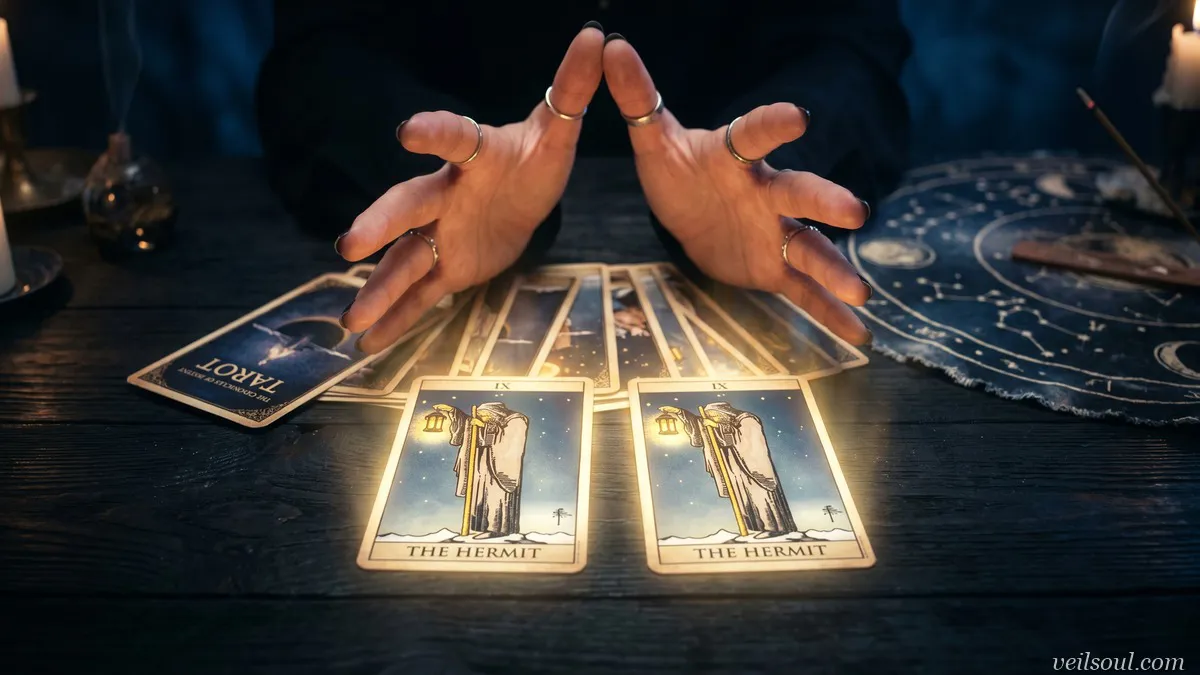
You pulled The Hermit. Noted it. Put it back. Shuffled for a solid two minutes — overhand, riffle, cut, the works. Drew again. The Hermit. Same cloaked figure. Same lantern. Same mountain. Staring at you with the calm patience of someone who has all the time in the world to wait for you to get the message.
Pulling the same card twice doesn't happen often in a properly shuffled 78-card deck — the probability is roughly 1 in 78, or about 1.3%. It's uncommon enough to feel meaningful and common enough that every regular reader has experienced it. What matters isn't the statistical probability. It's what the repetition is communicating.
Same Card Twice in One Session
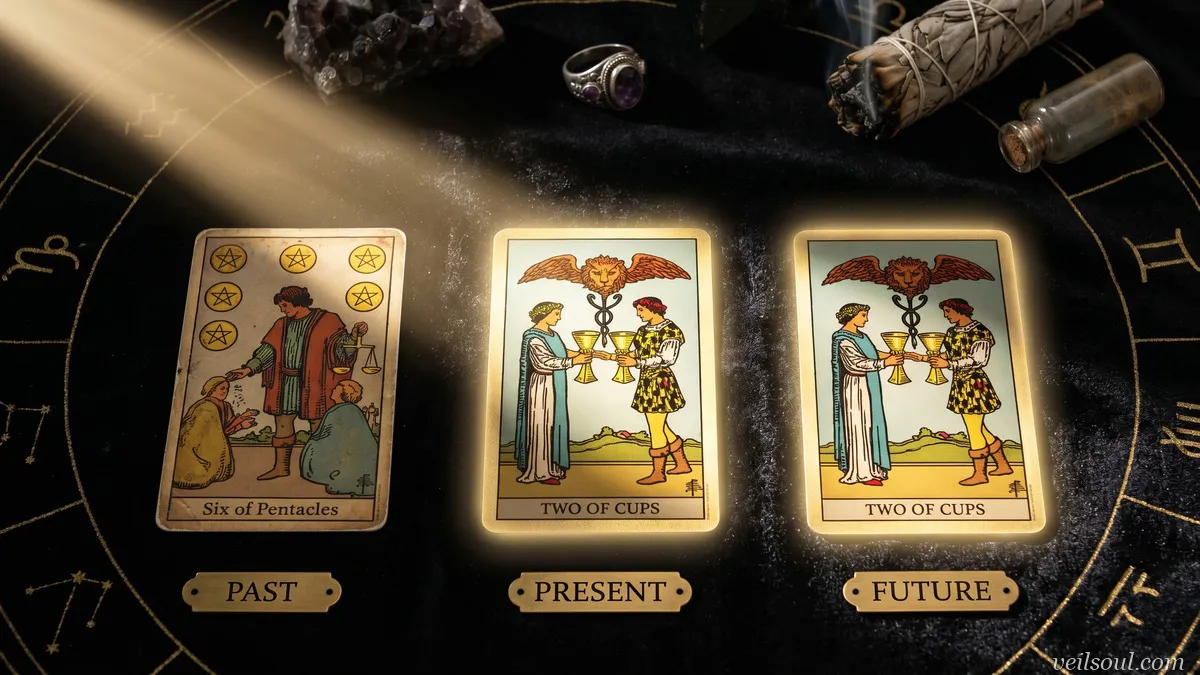
When the same card appears twice in a single sitting — whether in the same spread or across two separate pulls — the message is amplification. The deck is speaking louder.
First appearance: Here's what you need to know.
Second appearance: No, seriously. Here's what you need to know.
The Five of Cups appearing once says: something is causing you grief, and you're focused on what you've lost. The Five of Cups appearing twice says: you're so focused on the three spilled cups that you've completely lost sight of the two still standing behind you — and this fixation is actively shaping your decisions right now. The second pull isn't repetition. It's escalation.
Pay attention to the positions. If the card appeared in your "past" position and then again in your "guidance" position, the message is: the lesson from your past is your medicine for the present. If it appeared in "challenge" and then in "outcome," the obstacle and the destination are the same energy — you have to go through the challenge, not around it.
"She pulled a three-card spread: past, present, future. Then pulled a separate card for guidance. Two of Cups appeared as her present card and her guidance card. Same card, two positions. 'The universe is not being subtle,' I said. The Two of Cups — two figures facing each other, cups raised in mutual offering, the caduceus of healing rising between them — in her present and her guidance. 'Connection is both your current reality and your prescription,' I told her. 'You already have the relationship that's going to heal you. You're just not fully showing up to it.' She'd been keeping her new partner at arm's length — close enough to enjoy, far enough to avoid vulnerability. The double Two of Cups was the deck saying: stop hedging. Go all in. This one is real."
Same Card Across Different Readings
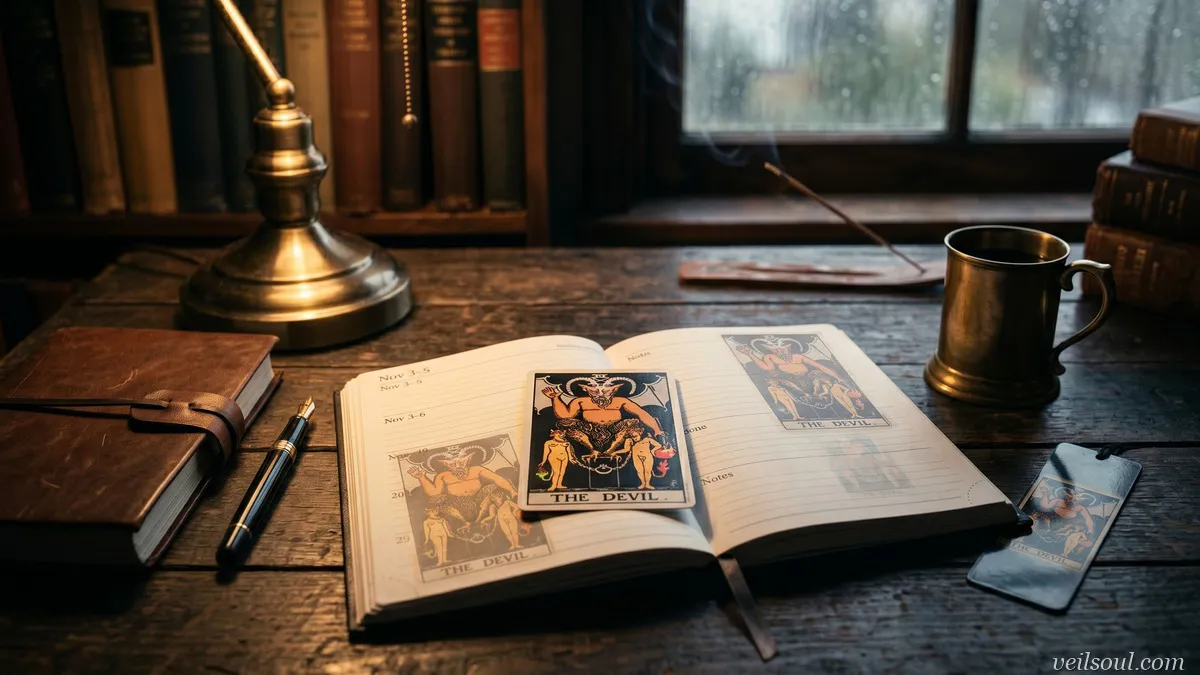
When a card appears in Tuesday's reading and again in Saturday's — different questions, different spreads — it's pointing to a life theme that transcends any single question.
This is different from same-session repetition. Same-session is emphasis within a moment. Cross-reading repetition is a through-line in your life. The card is saying: regardless of what you're asking about, this is what's actually happening.
You asked about your career on Tuesday and got The Devil. You asked about your health on Saturday and got The Devil again. The career question and the health question seem unrelated — but The Devil is connecting them. Those loosely chained figures on the dark pedestal. You're bound to something that's affecting every domain of your life — and until you address the binding itself (not the symptoms it creates in career or health or relationships), the card will keep appearing. For deeper exploration of repeating cards, see our guide to cards that keep appearing.
What to Do When It Happens
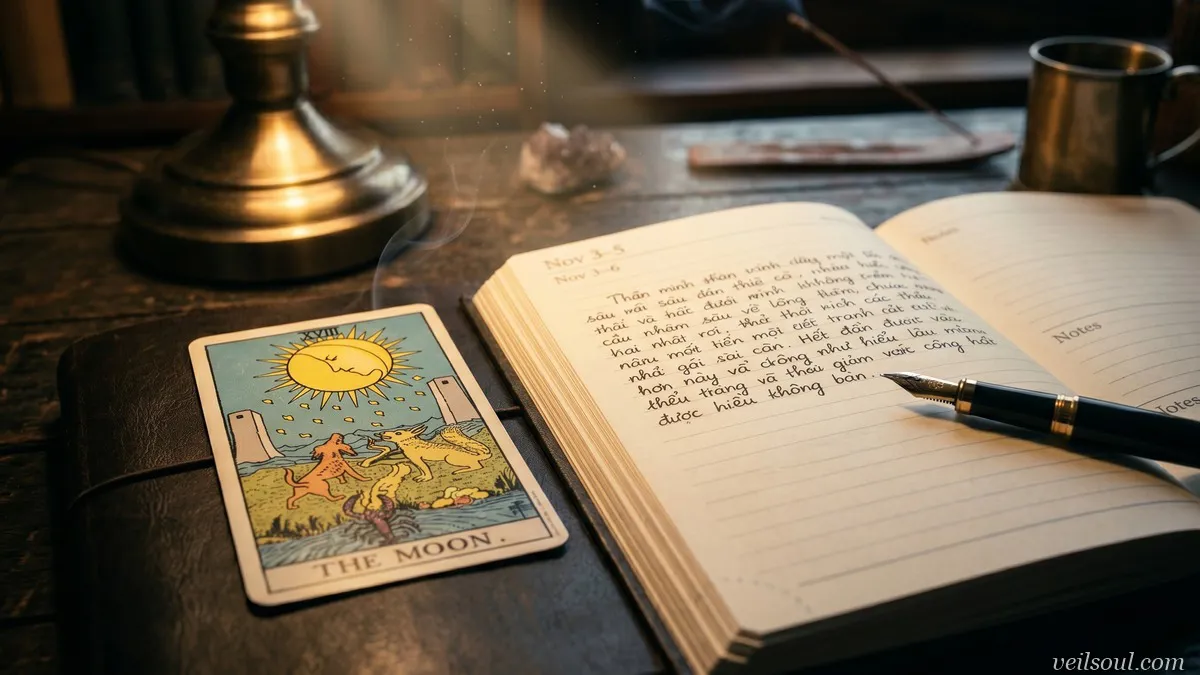
Don't just acknowledge the repetition — work with it. Here's a practical protocol.
- Stop and study the card. Not the meaning you remember — the actual image. Spend three full minutes looking at the card. What details have you been glossing over? The background, the colors, the expression on the figure's face, the objects in the margins. The repeated card is asking for deeper seeing, not faster interpretation.
- Journal the question: "What about this card am I avoiding?" The repetition exists because something in the message hasn't landed. Usually, it's the uncomfortable part — the implication you acknowledged intellectually but didn't let touch you emotionally. Write until you find the thing that makes your pen slow down. That's it. That's the message.
- Take one action. The Eight of Cups twice means leave something — today, not eventually. The Fool twice means take the leap — now, not when you feel ready. The Star twice means be vulnerable — with someone specific, not in theory. Action completes the circuit the card has been trying to close.
- Don't pull again on the same question. Two appearances is enough data. A third pull seeking a different answer is avoidance, not inquiry. Live with the message. Let it work on you. The card said what it said. Twice. Honor that by acting on it rather than continuing to shuffle and ask again. The cards have spoken. Your turn to move.
Why Double Pulls Matter More Than You Think
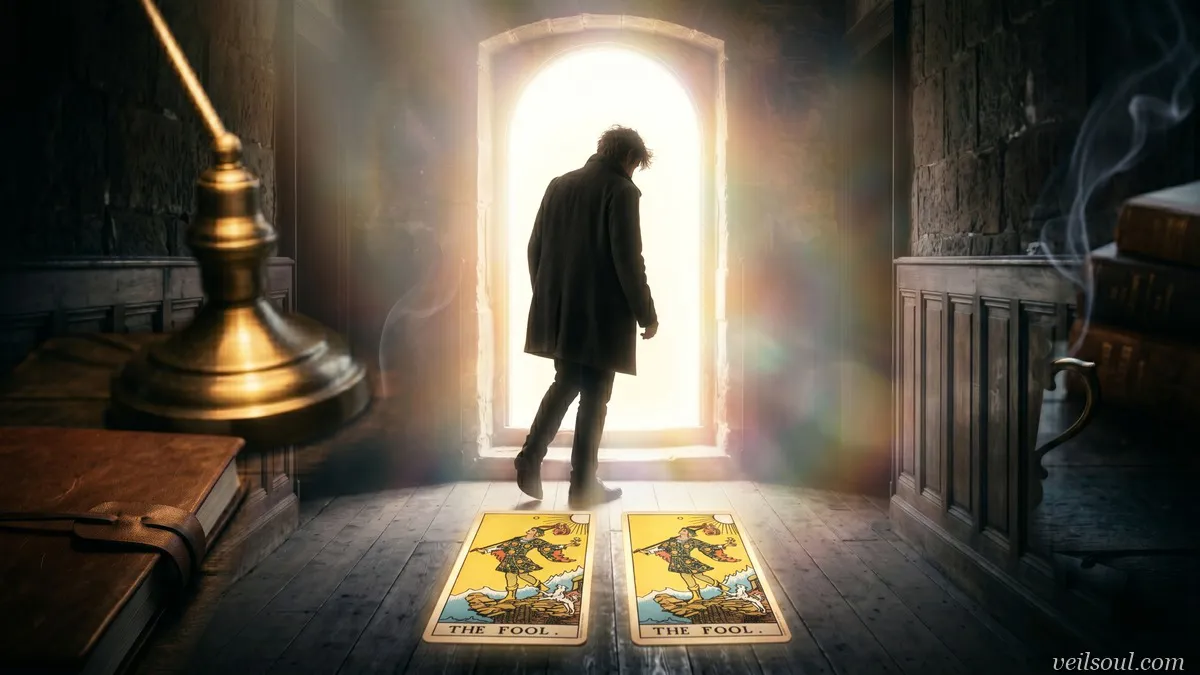
A double pull is diagnostically valuable. It tells you not only what the message is, but how urgently the message needs to be received.
In my practice, double pulls correlate strongly with situations where the querent is at a genuine decision point — not a theoretical decision, but an active fork where delay itself is a choice with consequences. The Fool appearing twice often precedes a leap delayed too long. The Tower twice typically surfaces when a structure is cracking and the person is applying temporary patches instead of addressing the foundation.
The double pull is the deck's urgency indicator. A single appearance says: here is information. A double says: here is information you need to act on now, not eventually, not when you feel ready — now. The timing of a double pull is almost never accidental. It arrives at the moment when the gap between knowing and acting has become the problem itself.
Rachel Pollack observed that repeated cards in a session often correspond to what she called "threshold moments" — points in a person's life where they're standing at a doorway, able to see the other side, but not yet willing to step through. The repeated card is the doorway, appearing twice because the person keeps looking at it and turning away. The second appearance is the deck saying with unmistakable, insistent clarity that cannot be ignored: the doorway won't wait forever.
When the Same Card Appears Upright Then Reversed (or Vice Versa)
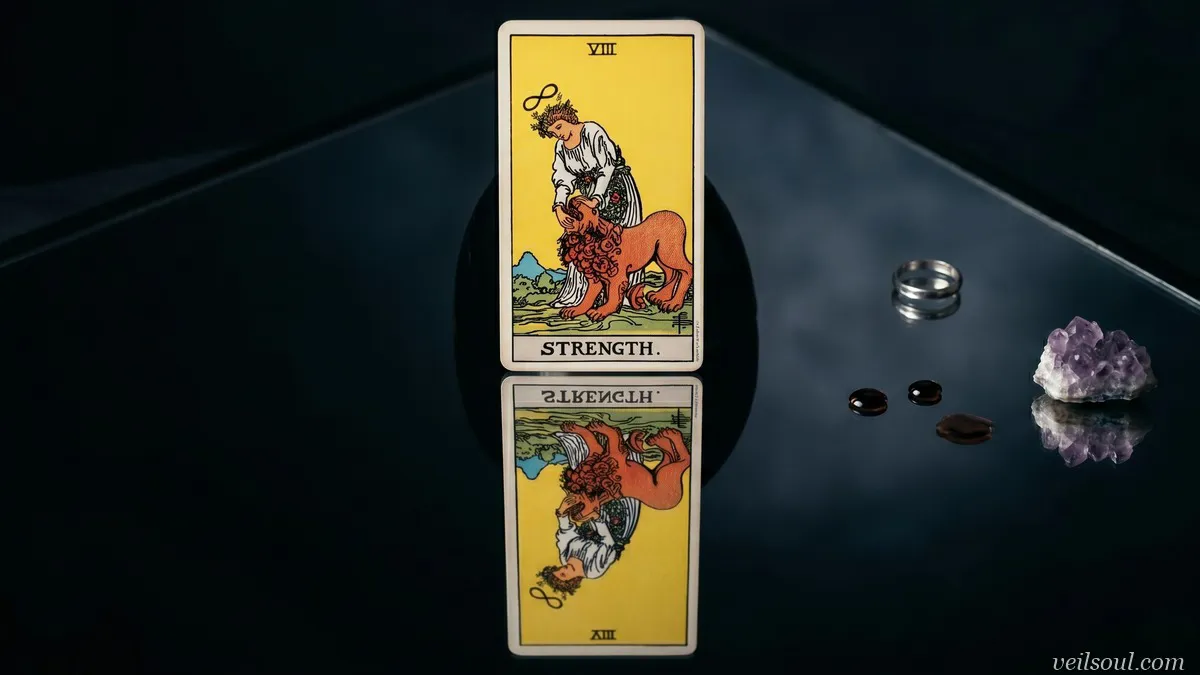
This variation carries its own specific message: the energy is shifting. The card is showing you the same theme from two different angles.
Strength upright — the woman gently holding the lion's jaw with calm courage — followed by Strength reversed in the same session suggests: you have the courage (upright) but you're not using it (reversed). Or conversely: you've been forcing something with brute will (reversed first) and the invitation is to try gentleness instead (upright second).
The upright-to-reversed shift often means: you understand this energy consciously (upright) but it's blocked in practice (reversed). The reversed-to-upright shift means: what was stuck is beginning to flow. The same card in two orientations is a before-and-after snapshot — the transition itself is the message.
Mary K. Greer noted that orientation shifts within a session frequently correspond to moments of realization during the reading itself — the card literally changes direction as the querent's understanding shifts. Whether this is synchronicity or selective perception, the practical result is the same: pay attention to the pivot.
Frequently Asked Questions
Could it just be bad shuffling?
Possible, but less likely than you'd think. Seven riffle shuffles randomize a standard deck. If you're shuffling thoroughly and the same card appears twice, the mechanical explanation becomes less satisfying. That said, always check your shuffle technique first — especially with new or sticky decks. If your shuffling is solid and the repetition persists, the message is worth examining. See our tarot technique guide for proper shuffling methods.
Does pulling the same card twice mean the first reading was wrong?
No — it means the first reading was incomplete. The second appearance deepens or redirects the interpretation. Think of it as the deck saying: "You heard me, but you didn't hear all of me." Both readings are valid; the second one adds a layer the first one started. For more on reading accuracy, see can tarot cards be wrong.
What if the same card appears in every reading for a week?
Then it's no longer a double-pull — it's a recurring card, and it signals a major life theme. Daily repetition over a week means the theme is urgent and active. Stop reading and start acting on the card's message. The repetition will stop when the lesson is integrated.
Should I be worried if the repeated card is a "scary" one?
Death twice doesn't mean double death. The Tower twice doesn't mean catastrophe squared. Repetition means emphasis, not escalation. The card appearing twice is saying: this transformation/disruption is important and you need to engage with it fully. It's actually more concerning to ignore a repeated challenging card than to face it.
A card that appears twice has spoken. Not whispered — spoken. In a 78-card deck, pulling the same card again is the equivalent of someone calling your name in a crowded room: unlikely, deliberate, and worth your full attention. You can analyze the probability or you can listen to the message. The card doesn't care which you choose. It already said what it came to say. Twice.
The double-pull that changed my own practice: The World, twice, on the day I was considering closing my reading practice. The cosmic dancer inside the laurel wreath of completion — appearing once to say "a cycle is ending" and again to say "but not the way you think." I didn't close my practice. I transformed it. The World wasn't telling me to stop. It was telling me to complete one chapter so the next one could begin. Two cards. One sentence. A decade of new direction.
Ready to hear what your cards are saying? Try a free reading with Veil Soul, or explore our self-reading guide for deeper practice.
chat_bubble 0 Comments
Leave a Comment